
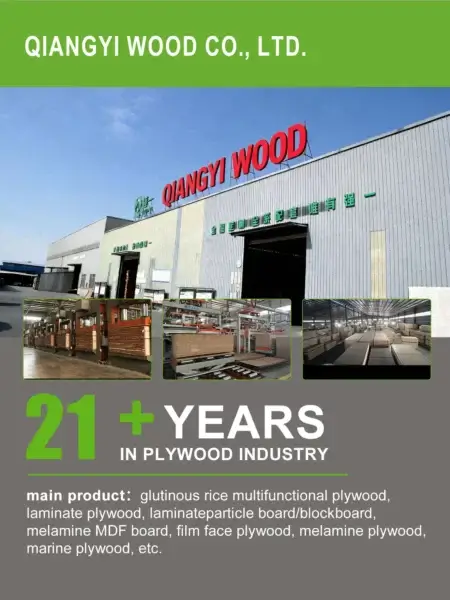


Produttore di compensato da 21 anni, servizio OEM, soluzione completa per l'approvvigionamento di compensato, al miglior prezzo e con il miglior servizio.
casa
Main products: Marine plywood, Melamine plywood, Melamine blockboard, Melamine Chipboard, Melamine MDF board, Film face plywood, Edge banding, Furniture accessories
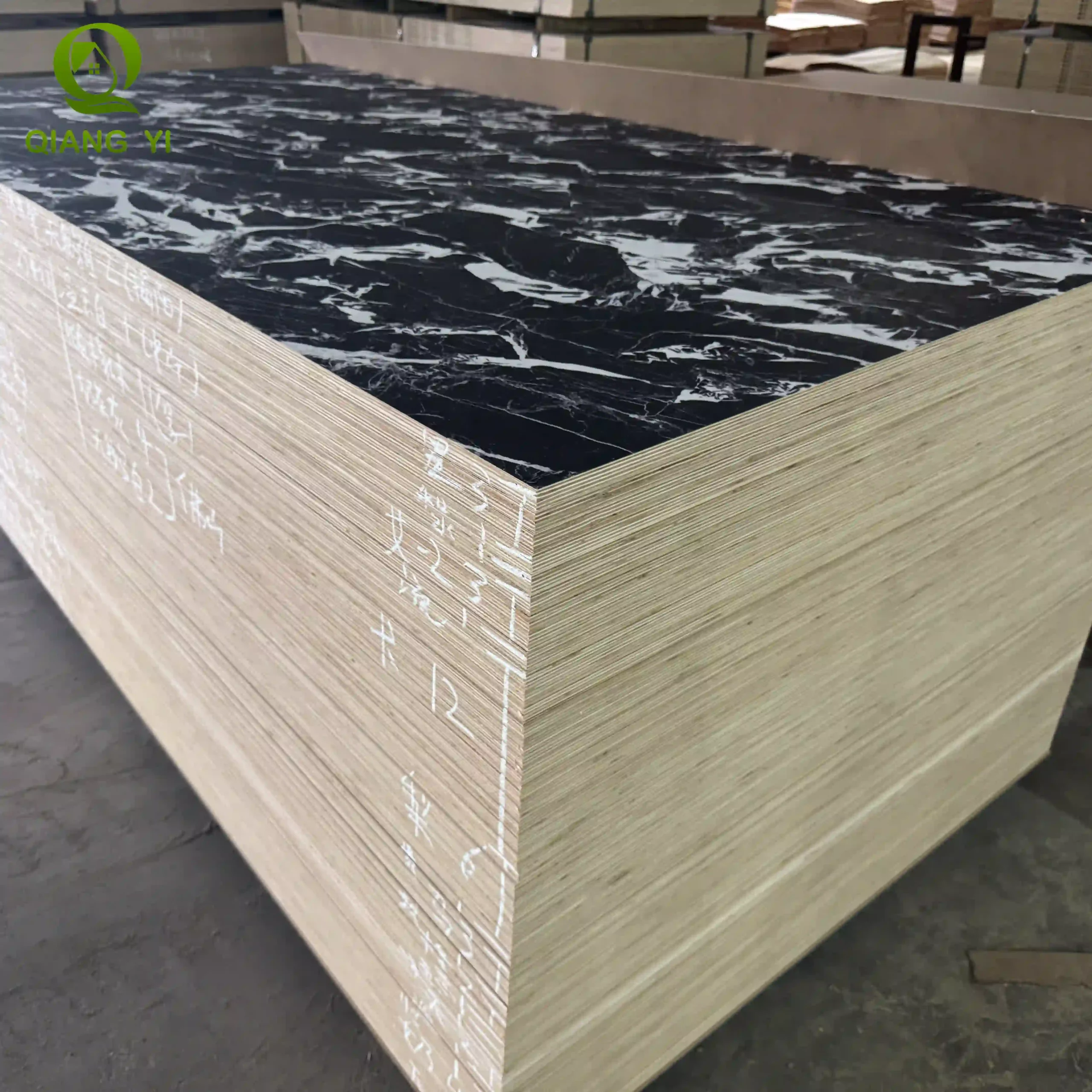
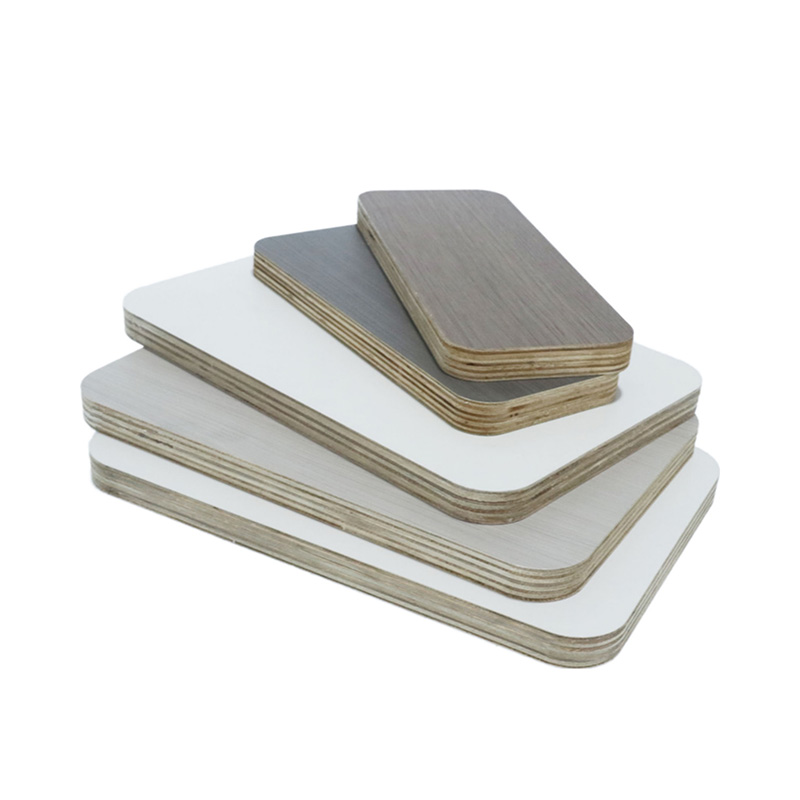
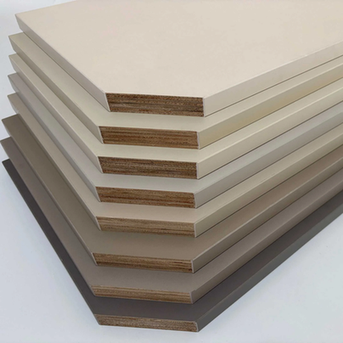
Compensato melaminico impermeabile di tutti i colori
Dimensioni: 5-25 mm (4*8 piedi)Caratteristiche: Resistenza al fuoco, Anticorrosione, Ecologico, Resistente all'acqua
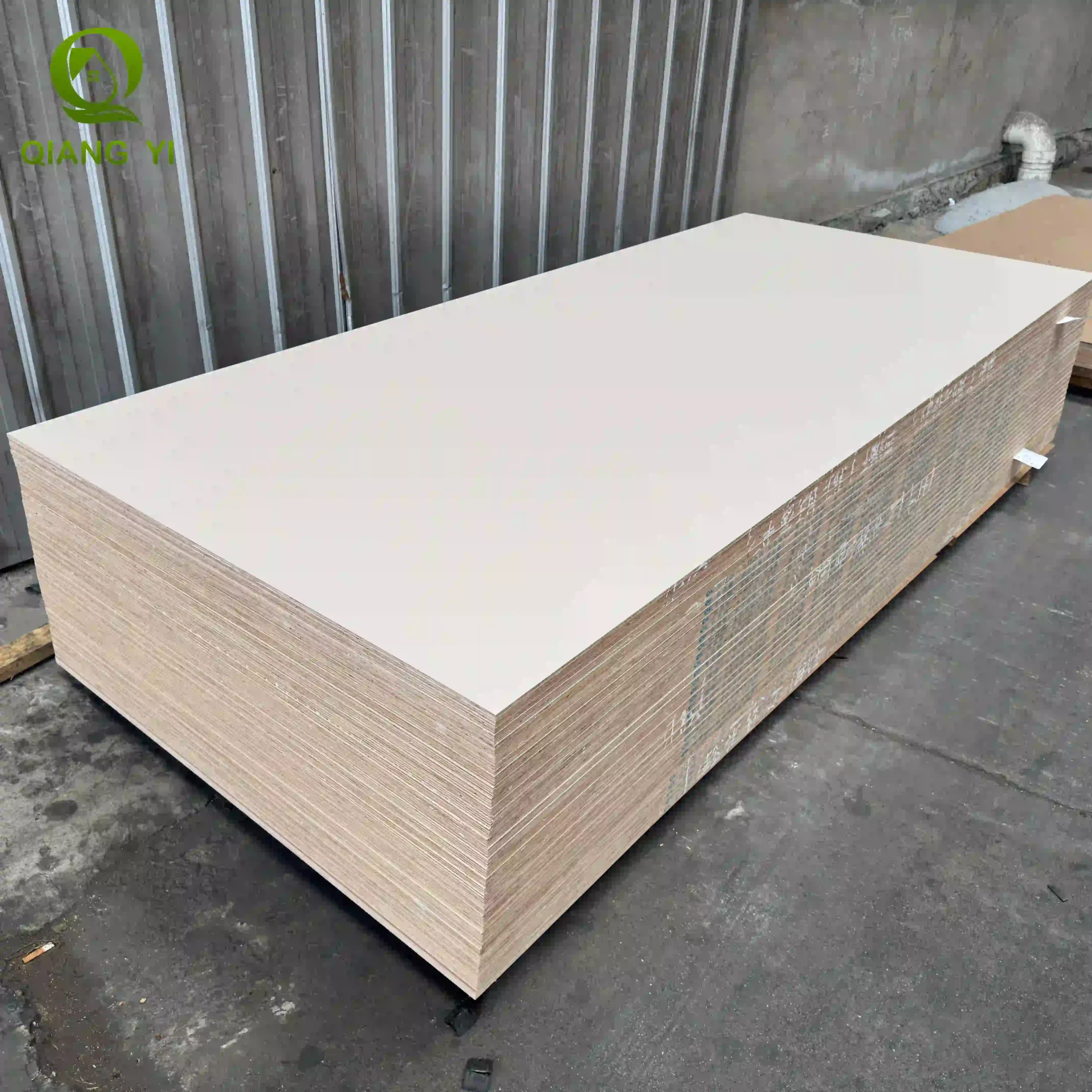
Compensato marino di riso glutinoso da 18 mm
Dimensioni: 5-25 mm (4 * 8 piedi e 4 * 9 piedi)Caratteristiche: resistente alle termiti, impermeabile, ignifugo, antideformazione, antimuffa, basse emissioni di formaldeide, resistenza alla corrosione, resistenza chimica e resistenza alle macchie.
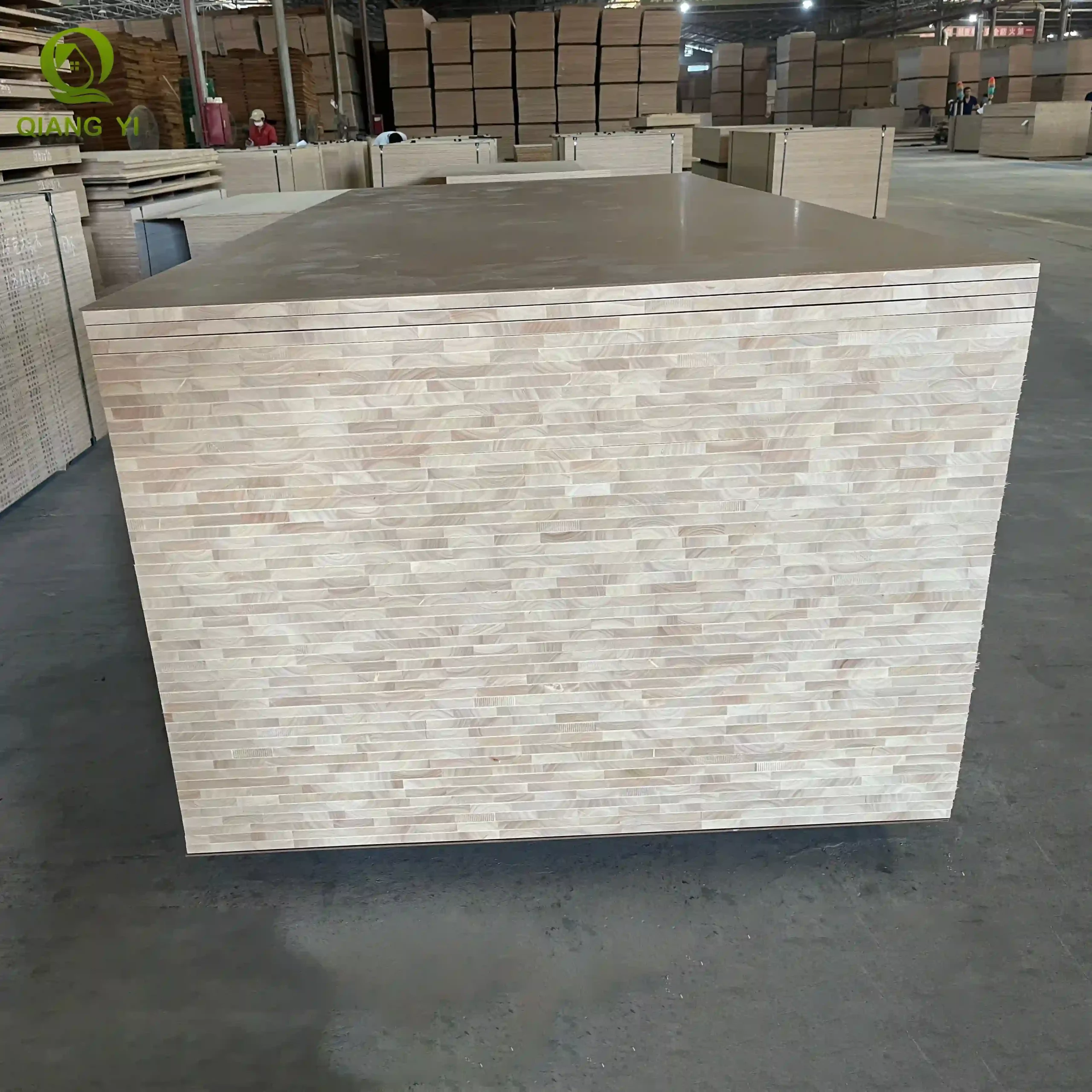
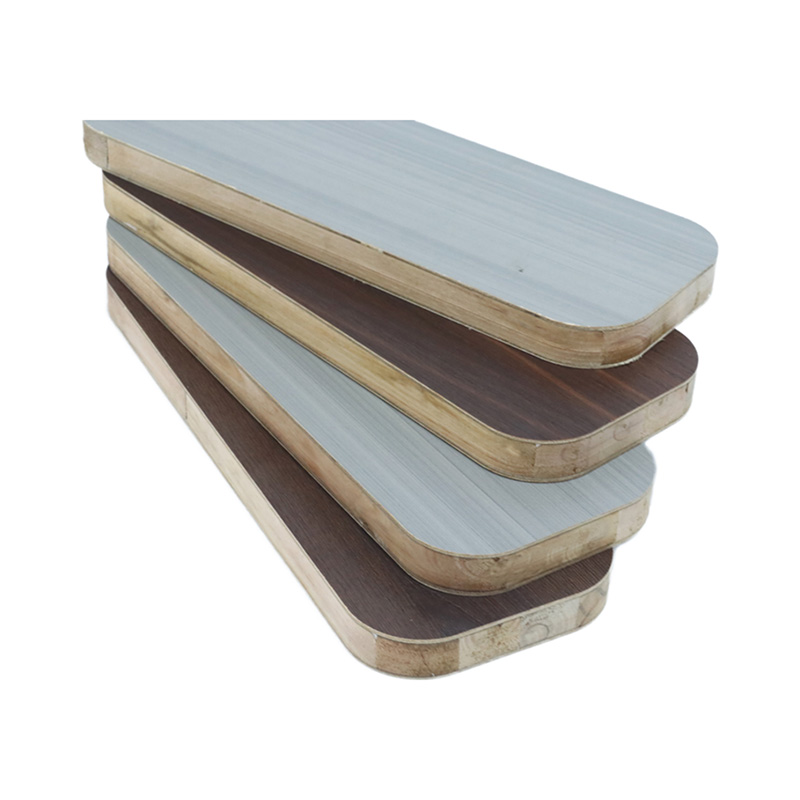
Pannello in melaminico con anima in eucalipto/abete/quercia
Dimensioni: 18 mm (4 * 8 piedi e 4 * 9 piedi)Caratteristiche: basso contenuto di formaldeide, resistenza alla flessione e alla fessurazione, elevata stabilità meccanica, elevata capacità di carico.
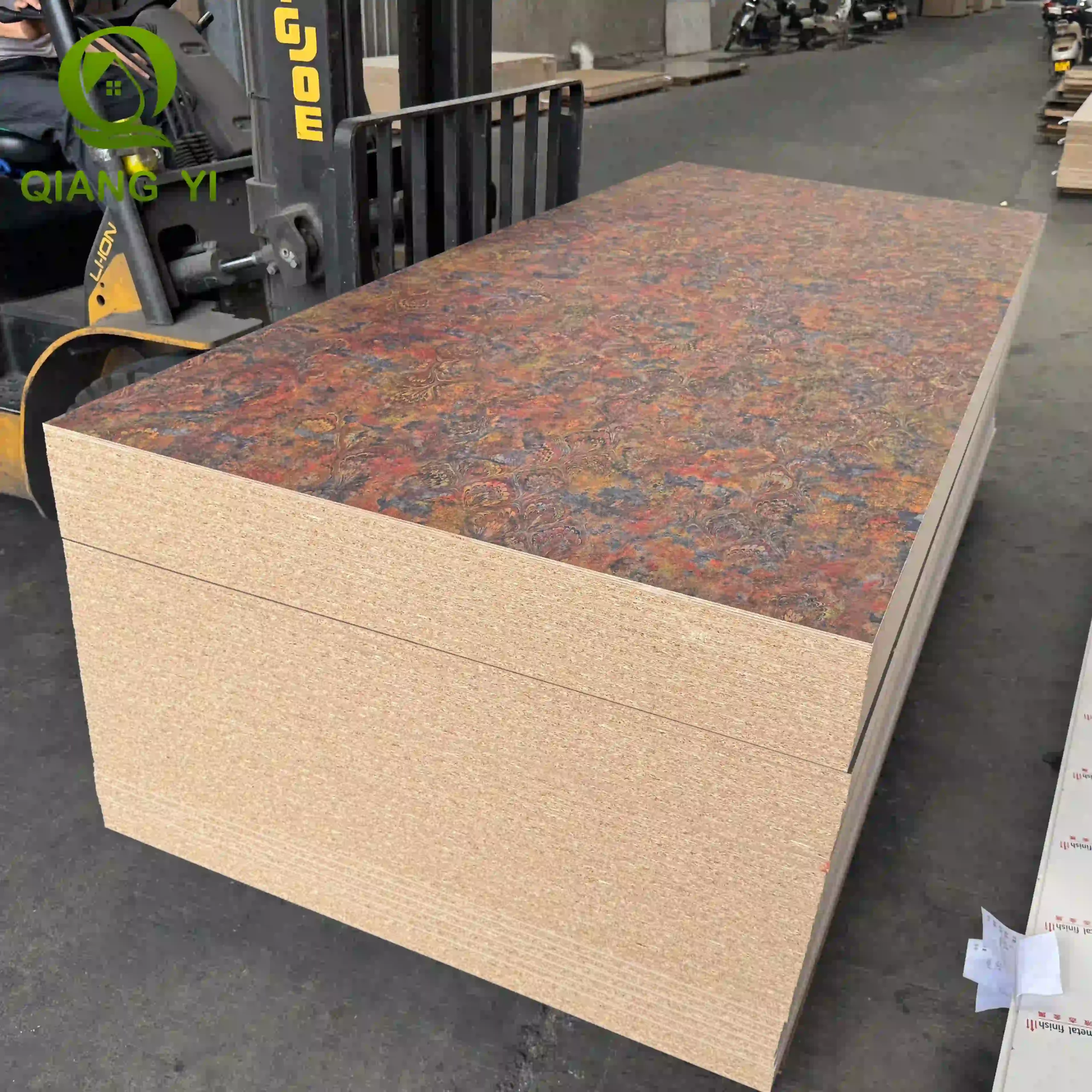
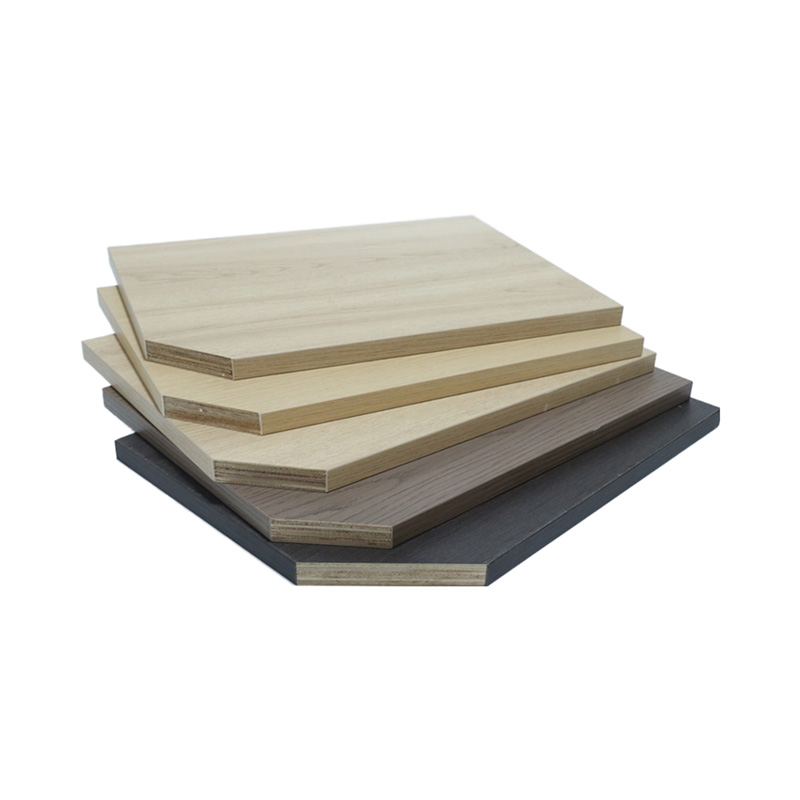
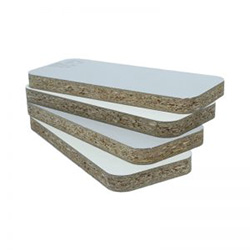
Truciolato melaminico di alta qualità
Dimensioni: 18 mm (4 * 8 piedi e 4 * 9 piedi)Caratteristiche: protezione ambientale, resistenza all'abrasione, resistenza alle alte temperature, diversi modelli e colori
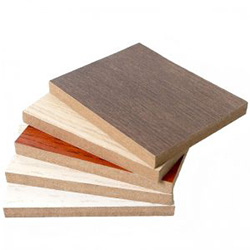
Pannello in MDF melaminico di grado E0/E1
Dimensioni: 9-30 mm (4 * 8/9/10 piedi)Caratteristiche: Resistenza alle alte temperature, resistenza alla corrosione, facile lavorazione, superficie liscia, con lavorazione relativamente semplice, e l'effetto decorativo presenta un aspetto più bello e appropriato.
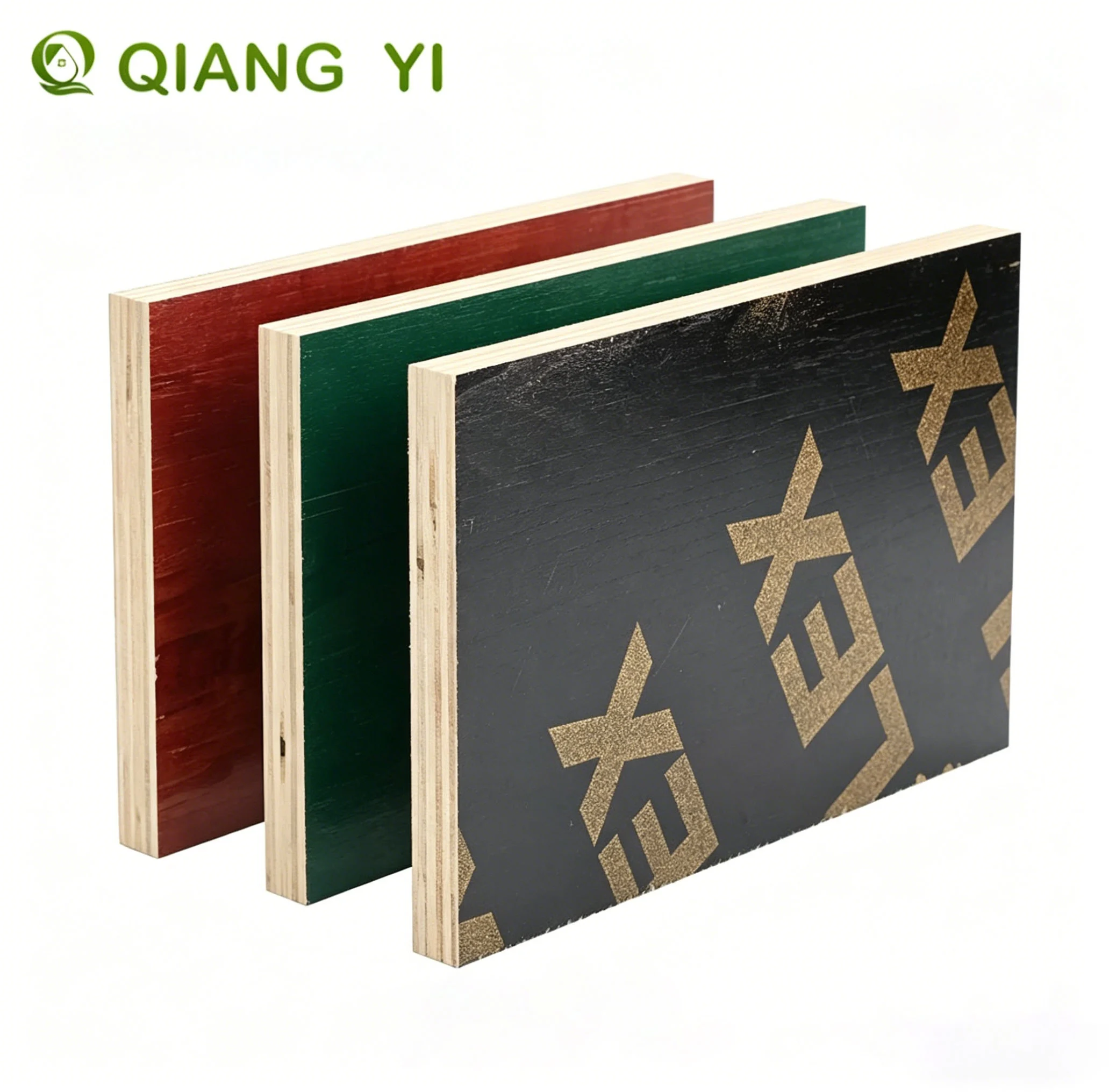
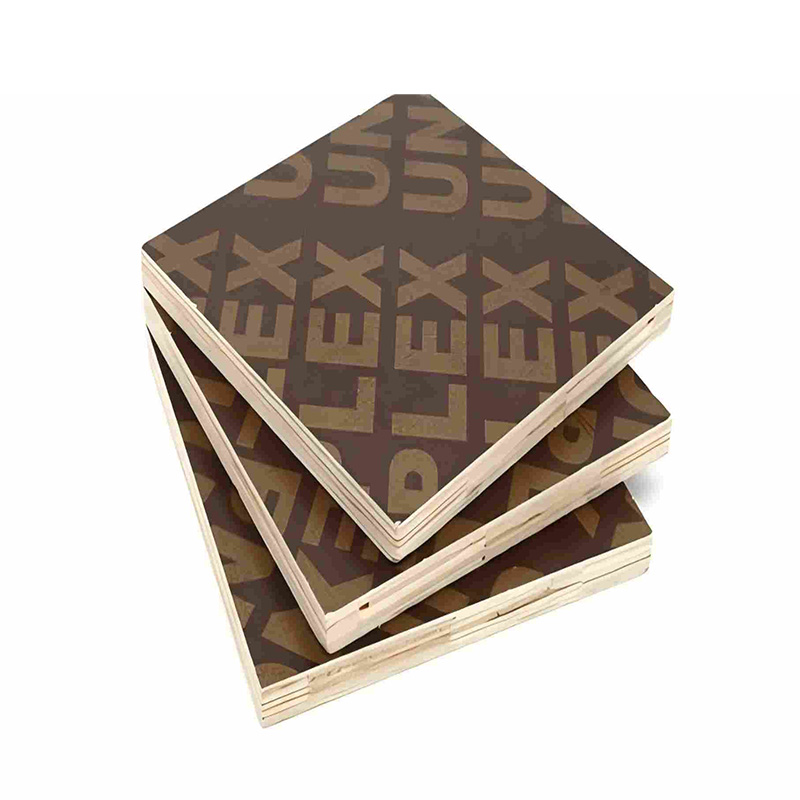
Compensato con pellicola rossa/verde/nera/marrone
Dimensioni: 10-21 mm (3*6 piedi e 4*8 piedi)Caratteristiche: Resistente all'usura, impermeabile, elevata capacità di carico, non si deforma facilmente, liscio e piatto, facile da sformare, antiscivolo, lunga durata.
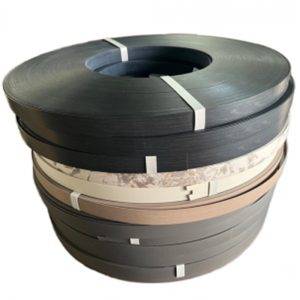
Bordatura in PVC di tutte le dimensioni e spessori
Materiale in PVC, resistente all'acqua, disponibile in tutti i colori, in tutte le dimensioni e spessori per diverse applicazioni, con una superficie perfetta.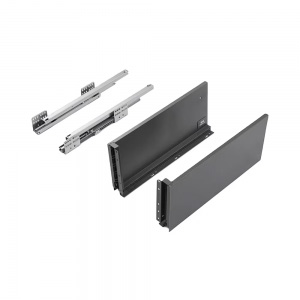
Accessori per mobili di ogni genere
Maniglie per armadi, guide per cassetti, cerniere, cassetti, ecc.Qiangyi Commercio (Guangxi) Co., Ltd.
Fondata nel 2004, QIANGYI è una moderna impresa di grandi dimensioni specializzata nella produzione di compensato impiallacciato preverniciato e non rifinito di alta qualità, compensato marino laminato, compensato melaminico, pannelli truciolari melaminici e compensato commerciale, ecc. Con oltre 500 dipendenti e più di 100 stabilimenti produttivi, che coprono una superficie di oltre 110.000 metri quadrati, la nostra produzione annua supera i 5,4 milioni di pannelli di compensato. Inoltre, siamo specializzati nella lavorazione di compensato marino, compensato/pannelli truciolari melaminici e pannelli di particelle con la nostra finitura in carta melaminica. Disponiamo delle certificazioni CE/CARB/ISO/CFCC, in quanto tutti i nostri modelli sono conformi ai requisiti di sicurezza dell'Unione Europea e degli Stati Uniti per i materiali da costruzione e l'arredamento.
Inoltre, offriamo servizi OEM per soddisfare esigenze specifiche e rispondere alle diverse necessità di mercato.

Anni Produttore

Zone industriali

Contenitori/Anno

Paesi/Mercati
Senza formaldeide, impermeabile, ignifugo, resistente alle termiti, antimuffa, indeformabile, resistente all'invecchiamento e insonorizzato.
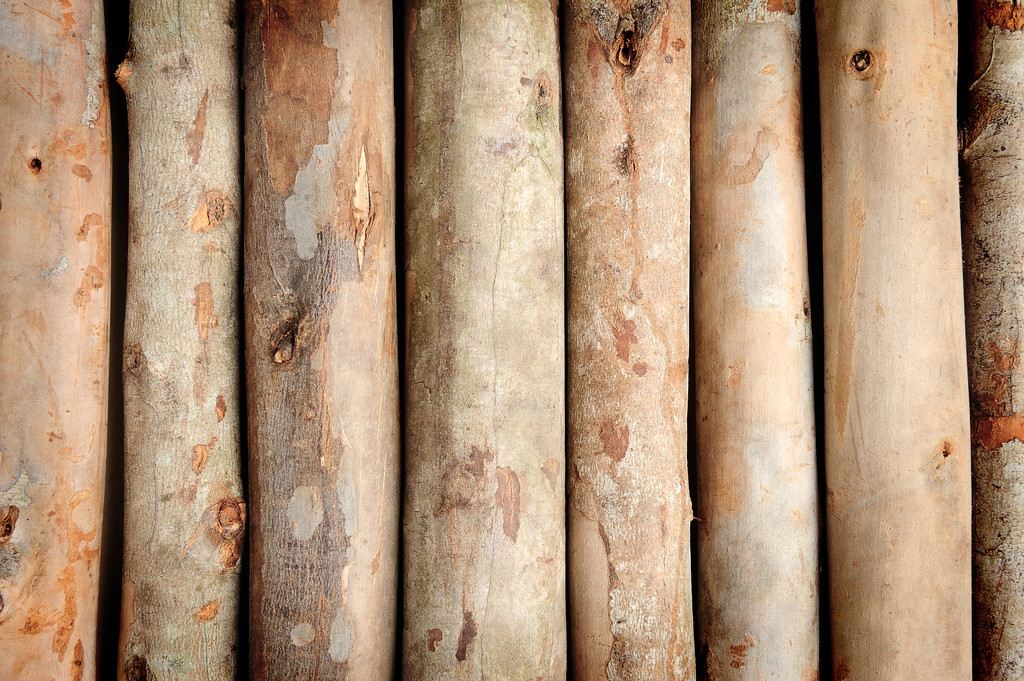
Panoramica del compensato di Qiangyi realizzato con colla di riso glutinoso
Le origini storiche del compensato di Qiangyi realizzato con colla di riso glutinoso
La Grande Muraglia è rimasta in piedi per migliaia di anni non solo grazie ai suoi spessi mattoni e pietre, ma anche grazie agli adesivi (colla) utilizzati nella sua costruzione. In termini di materiali edili, gli artigiani della dinastia Ming utilizzarono in modo creativo un magico "adesivo biologico": la malta di riso glutinoso. Mescolavano la colla di riso glutinoso cotta con calce spenta e sabbia per creare una pasta. L'amilopectina contenuta nel riso glutinoso reagiva chimicamente con la calce, producendo un materiale composito organico-inorganico eccezionalmente resistente, durevole e impermeabile. Questa è la chiave del perché molte sezioni della Grande Muraglia rimangono saldamente unite anche dopo secoli di erosione da vento e pioggia. Oggi, questa antica saggezza è rinata grazie alla tecnologia moderna. Il nuovo "compensato con colla di riso glutinoso" utilizza la stessa tecnologia adesiva a base di riso glutinoso impiegata per la Grande Muraglia.

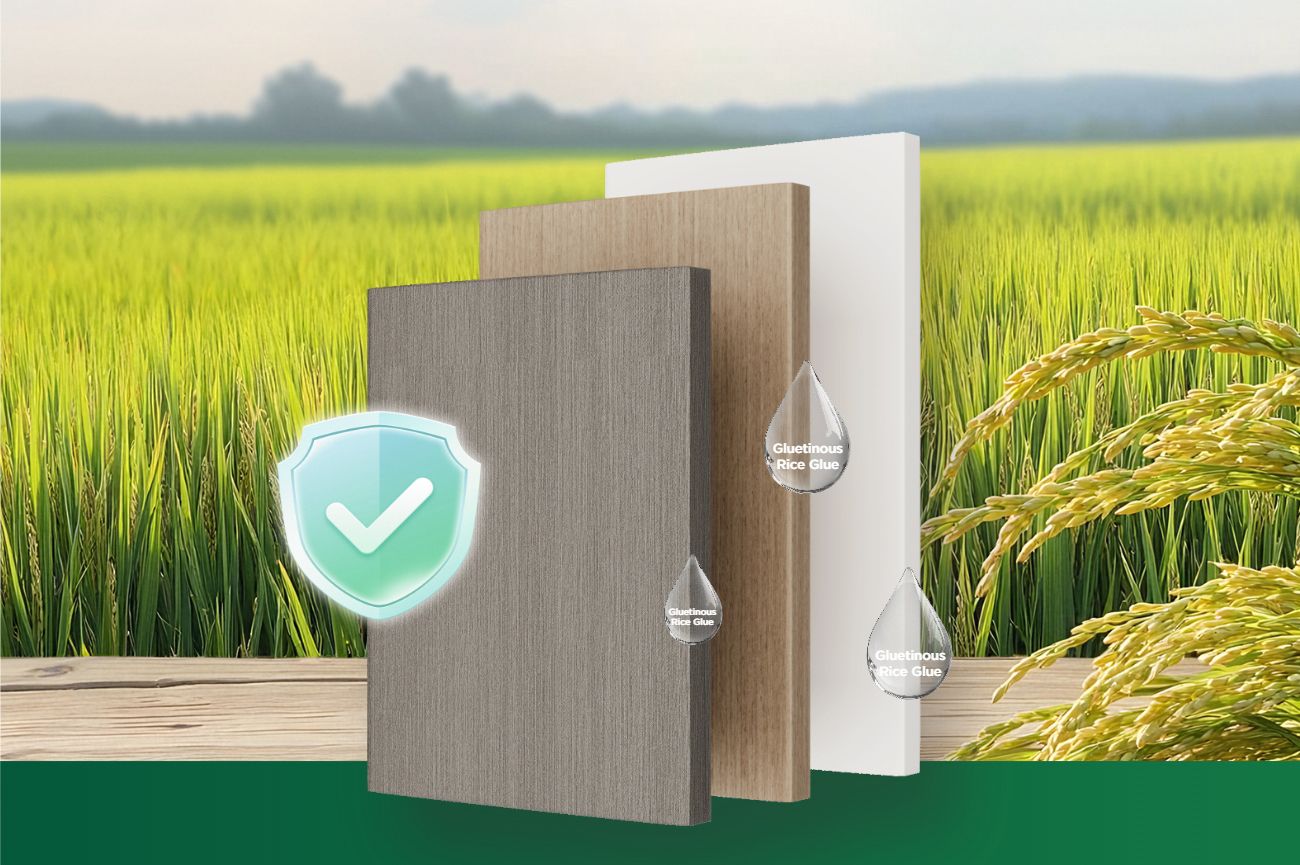
Panoramica del compensato di Qiangyi realizzato con colla di riso glutinoso:
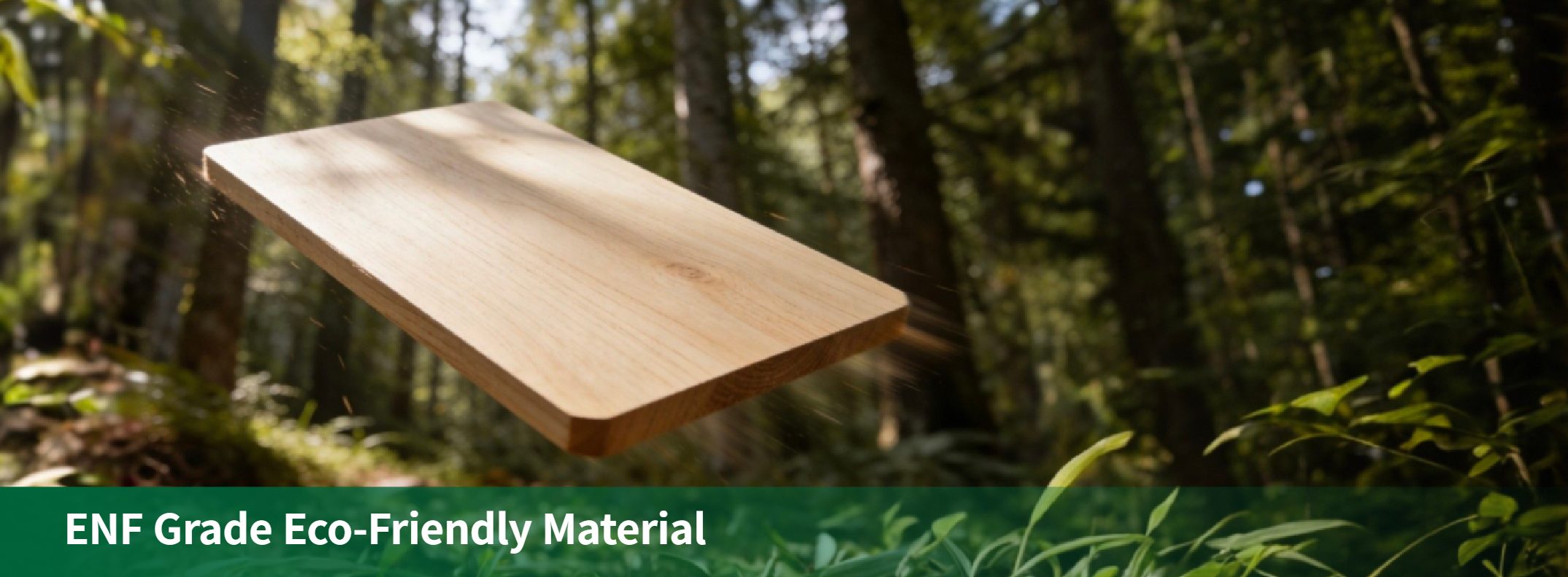
L'innovazione alla base del compensato di riso glutinoso risiede nell'ispirazione tratta dai principi dell'antica Grande Muraglia. Il compensato di riso glutinoso Qiangyi, noto anche come compensato di seconda generazione, rappresenta un secolo di innovazione. Ha raggiunto il primo posto nelle vendite e gode di un'ottima reputazione in Cina. È ampiamente apprezzato da imprese di ristrutturazione, produttori di mobili e privati. Utilizza colla di riso glutinoso Lingmei senza formaldeide e senza benzene come adesivo, impiallacciatura di eucalipto di grado AA come materiale di base, con aggiunta di cloruro di magnesio, acqua e ossido di magnesio. L'ossido di magnesio è un super ritardante di fiamma e agente isolante termico, con un punto di accensione di 2852 °C, che consente al compensato di riso glutinoso Qiangyi di raggiungere lo standard di resistenza al fuoco B1 (B3: Materiali infiammabili; B2: Materiali combustibili). Dopo la polimerizzazione, la colla di riso glutinoso crea un ambiente alcalino, mentre termiti e insetti prediligono un ambiente acido. Grazie alla sua elevata permeabilità, le termiti ingeriscono parte della colla di riso glutinoso insieme alle fibre di legno. La natura alcalina della colla è indigeribile, causandone la morte. Questa colla di riso glutinoso è prodotta con estratti vegetali/minerali puri, garantendo sicurezza e stabilità. Non prevede reazioni chimiche con aldeidi, eliminando così l'introduzione di formaldeide alla fonte e offrendo prestazioni ambientali eccezionali, raggiungendo il livello di protezione ambientale Super ENF. La pressatura a freddo e lo stampaggio autoriscaldante consentono l'immediata occupazione dopo l'installazione. In termini di prestazioni, la combinazione di impiallacciatura primaria e colla di riso glutinoso, lavorata attraverso più strati, conferisce al compensato un'elevata capacità di tenuta dei chiodi, resistenza alla deformazione, ignifugazione, resistenza all'acqua, all'umidità, alla muffa, proprietà antibatteriche e resistenza alle termiti, rendendolo un compensato multistrato di seconda generazione e un "guerriero a nove lati" nel settore del compensato.
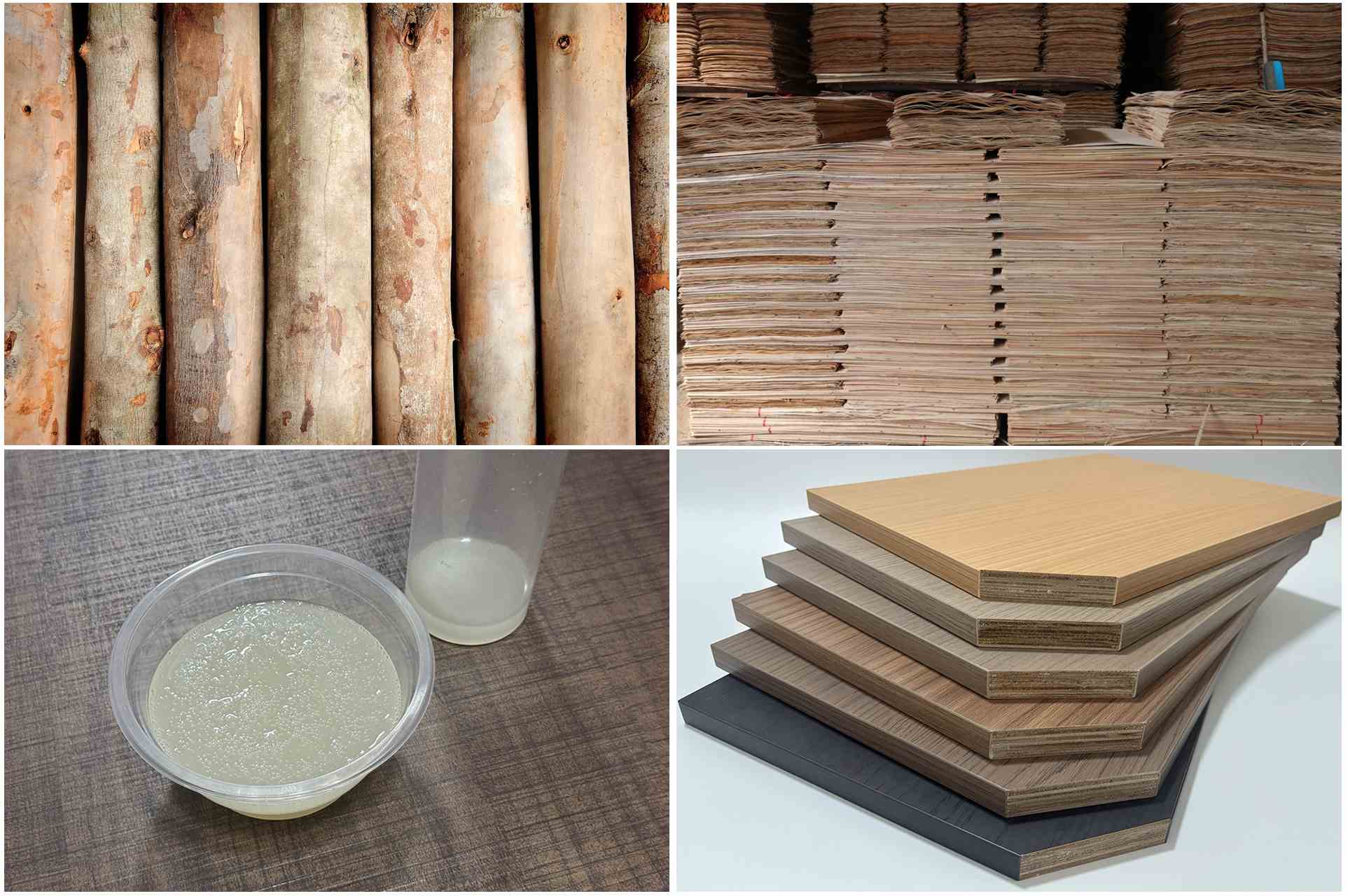
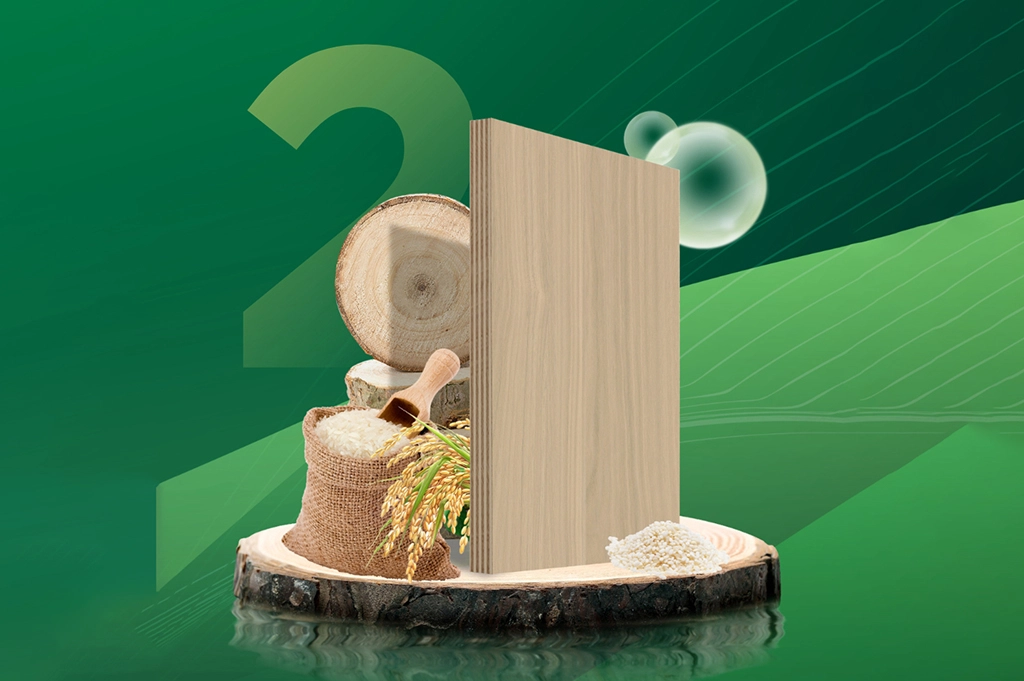
Funzioni del compensato di colla di riso glutinoso
Spiegazione delle funzioni del compensato di colla di riso glutinoso Qiangyi
- 1. Super ENF-grade-Salute e Ambiente
Colla di riso glutinoso Lingmei: Farina di riso glutinoso + cloruro di magnesio + acqua + ossido di magnesio. Questa colla di riso glutinoso è prodotta con estratti vegetali/minerali puri, garantendo sicurezza e stabilità. Non prevede reazioni chimiche con aldeidi, eliminando così l'introduzione di formaldeide alla fonte.
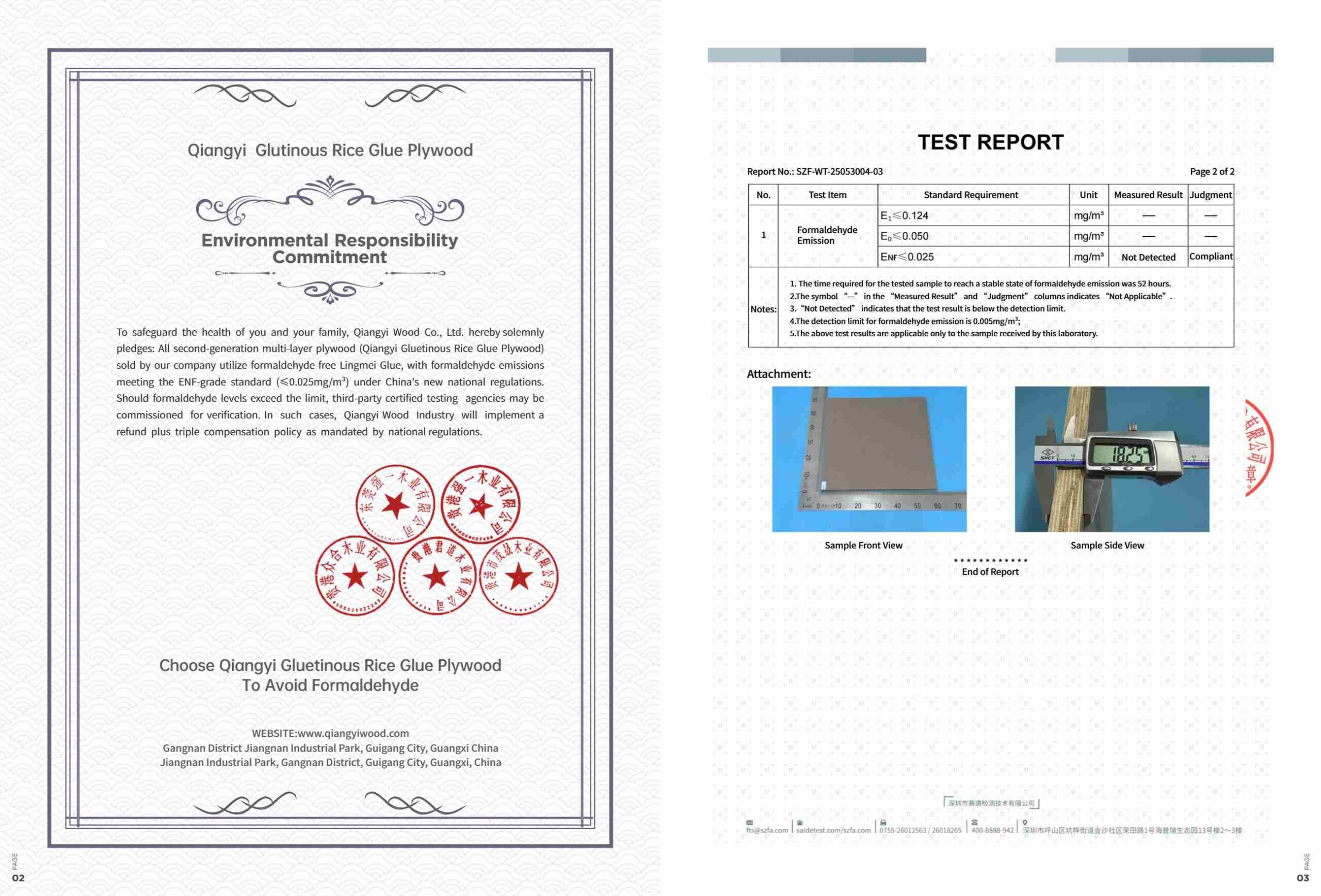
Protezione ambientale di livello Super ENF: il compensato con colla di riso glutinoso utilizza la colla di riso glutinoso Lingmei, priva di formaldeide, raggiungendo un livello di protezione ambientale di livello Super ENF con zero benzene. Rispetto alle tradizionali colle a base di resina urea-formaldeide (classi E0, E1 ed E2), il compensato con colla di riso glutinoso non solo presenta una normativa più rigorosa in materia di emissioni di formaldeide, ma mostra anche una minore variabilità e una struttura più stabile in diverse condizioni climatiche e di temperatura.
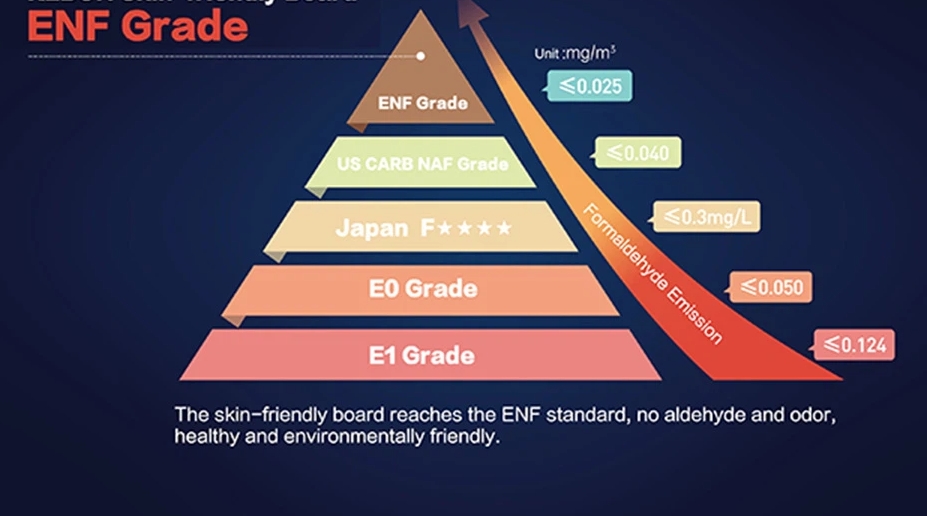
- 2. Inodore–Pronto per il trasloco
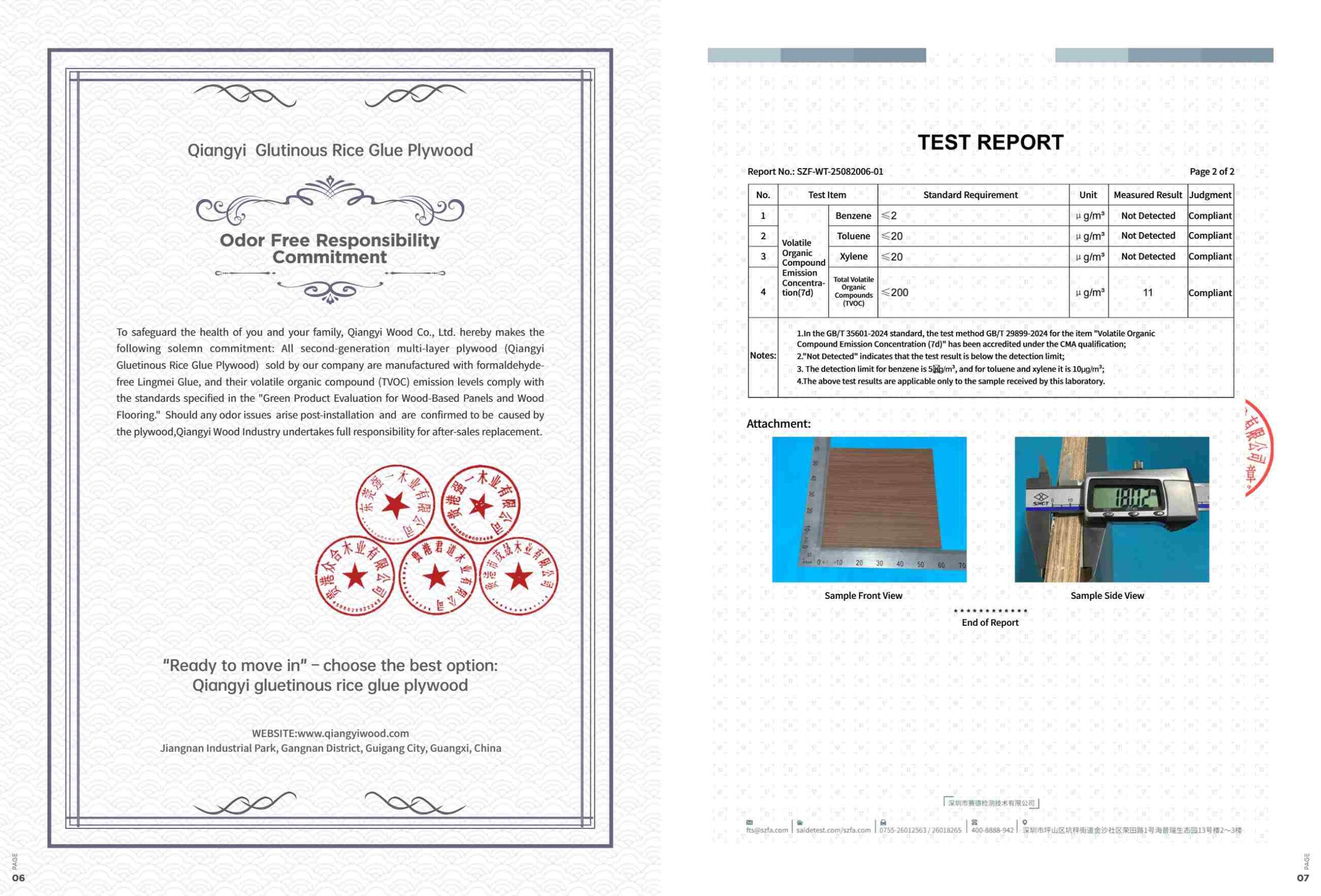
Eliminazione del problema alla fonte: durante il processo di produzione dell'adesivo non vengono aggiunte sostanze nocive come formaldeide, benzene o fenolo. Poiché la colla è completamente priva di formaldeide, la principale fonte di odori e inquinamento derivanti dai lavori di ristrutturazione viene eliminata alla radice.
Blocco degli odori estremamente efficace: dopo l'indurimento, la colla di riso glutinoso Lingmei forma una struttura reticolata stabile con le fibre del legno. Possiede proprietà chimiche stabili, una buona resistenza all'acqua e penetra rapidamente all'interno del legno. Allo stesso tempo, dopo l'indurimento, forma una struttura cristallina densa che trattiene saldamente l'odore del legno stesso. Inoltre, non si decompone facilmente in sostanze gassose, quindi è possibile abitare immediatamente dopo l'installazione.
- 3. Antimuffa(anti-deformazione)e antibatterico
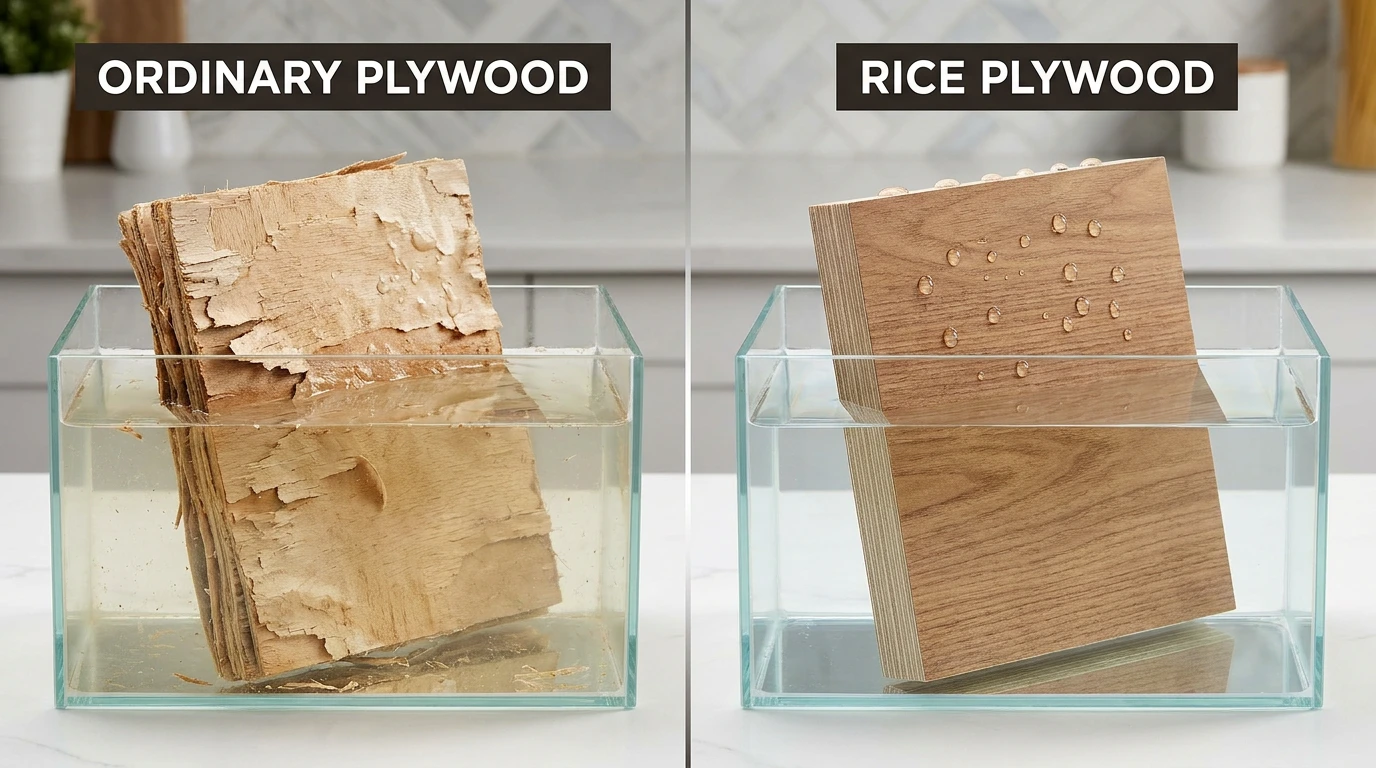
Resistenza alla muffa di grado 0, tasso antibatterico >99%: il cloruro di magnesio e l'ossido di magnesio contenuti nella colla di riso glutinoso Lingmei reagiscono creando un ambiente alcalino. In combinazione con il rigoroso processo di essiccazione a temperatura controllata di 60 ore, il contenuto di umidità del pannello viene controllato con precisione entro l'intervallo ottimale dell'8-12%. Allo stesso tempo, le sue eccellenti proprietà impermeabili e anti-umidità distruggono virtualmente l'ambiente di sopravvivenza di qualsiasi muffa. Cosa significa resistenza alla muffa di grado 0?
Offre una protezione superiore e di lunga durata: anche in ambienti estremi con temperature e umidità costantemente elevate, è in grado di inibire efficacemente la colonizzazione e la crescita delle spore di muffa per lungo tempo.
L'effetto è visibile a occhio nudo: la superficie è pulita e priva di macchie batteriche, non solo al microscopio ma anche osservandola durante l'uso quotidiano.
- 4. Capacità di tenuta dei chiodi e di carico superiori
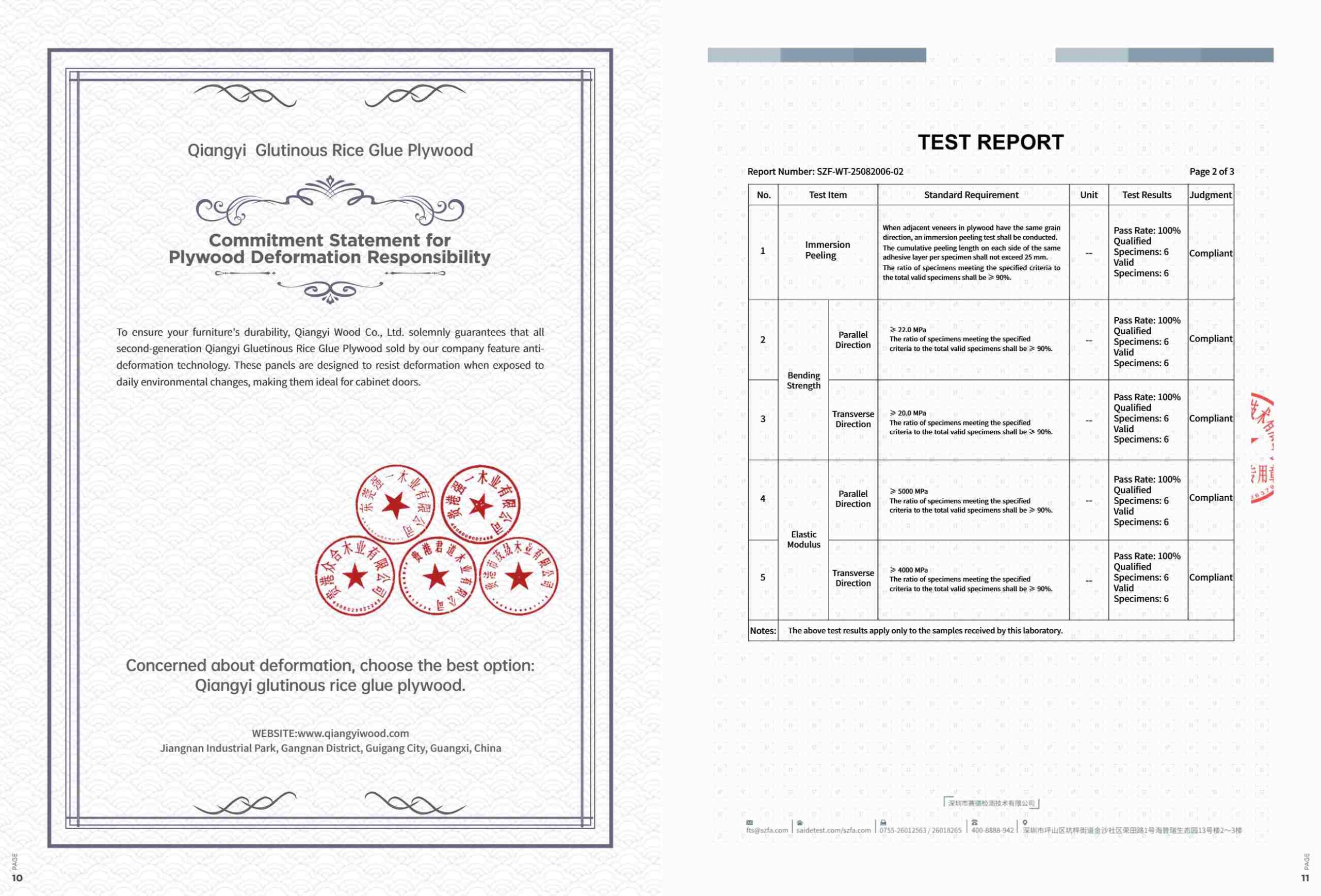
Capacità di tenuta dei chiodi superiore e maggiore resistenza alla deformazione: il truciolato è il materiale più diffuso sul mercato per le ante dei mobili, principalmente perché non si deforma facilmente. Tuttavia, la sua capacità di tenuta dei chiodi è molto scarsa e le ante tendono ad allentarsi dopo essere state aperte e chiuse ripetutamente. Il compensato di Qiangyi, realizzato con colla di riso glutinoso Lingmei, forma una struttura cristallina densa dopo la polimerizzazione. Questo materiale presenta un'elevata rigidità e non assorbe facilmente acqua né si gonfia. Pertanto, la sua resistenza alla deformazione è paragonabile a quella del truciolato. Allo stesso tempo, offre una capacità di tenuta dei chiodi e una capacità di carico superiori.
- 5. Inimpermeabile, resistente all'umidità e all'espansione
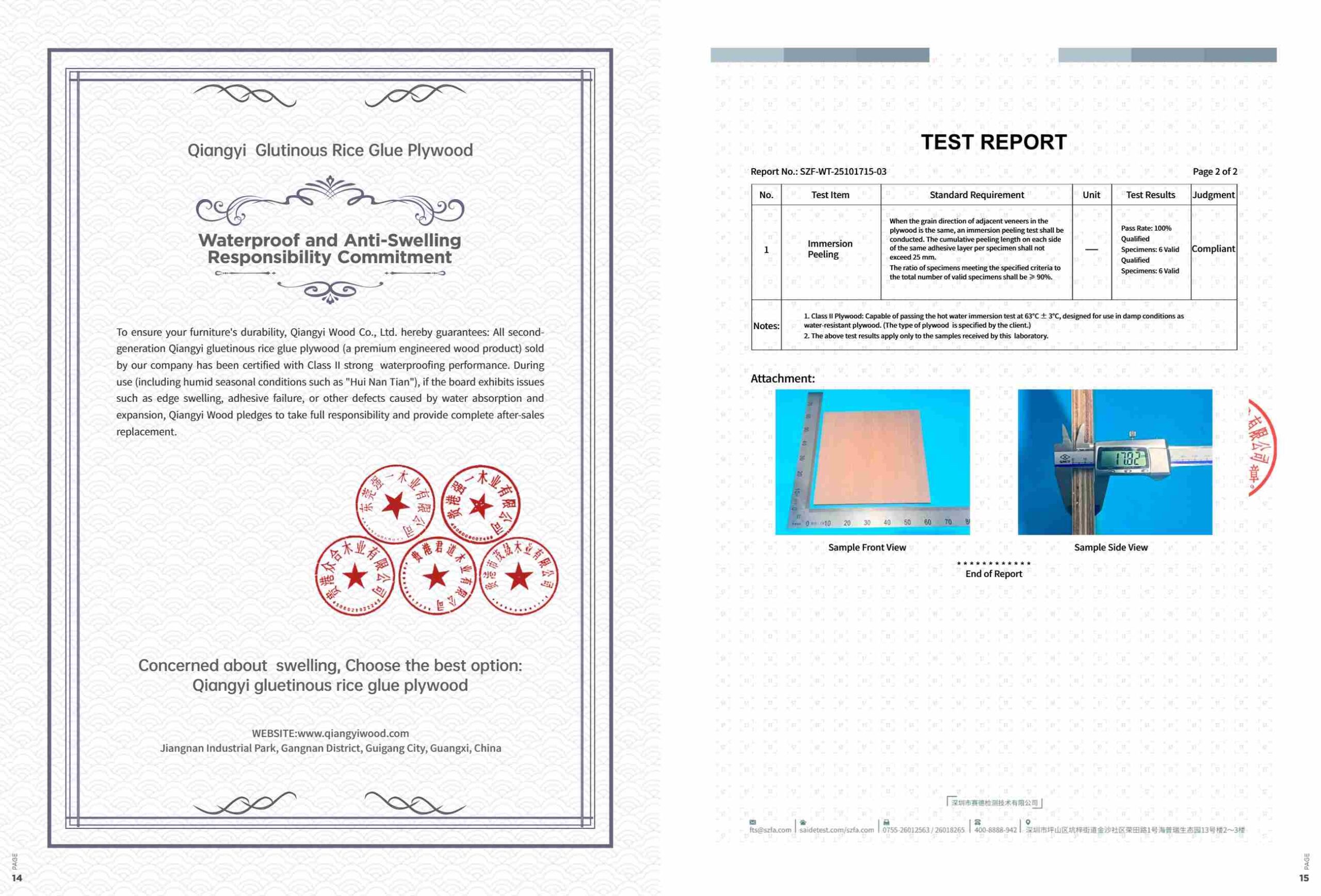
Impermeabile, resistente all'umidità e anti-rigonfiamento: la colla di riso glutinoso Lingmei ha una straordinaria capacità di penetrazione. Una volta applicata al nucleo del pannello, penetra rapidamente nella struttura interna, avvolgendo saldamente le fibre del legno e impedendo alle molecole d'acqua presenti nell'aria di entrare in contatto con esse, prevenendo così l'assorbimento di umidità e il conseguente rigonfiamento.
- 6. 9.5 grado resistenza alle termiti
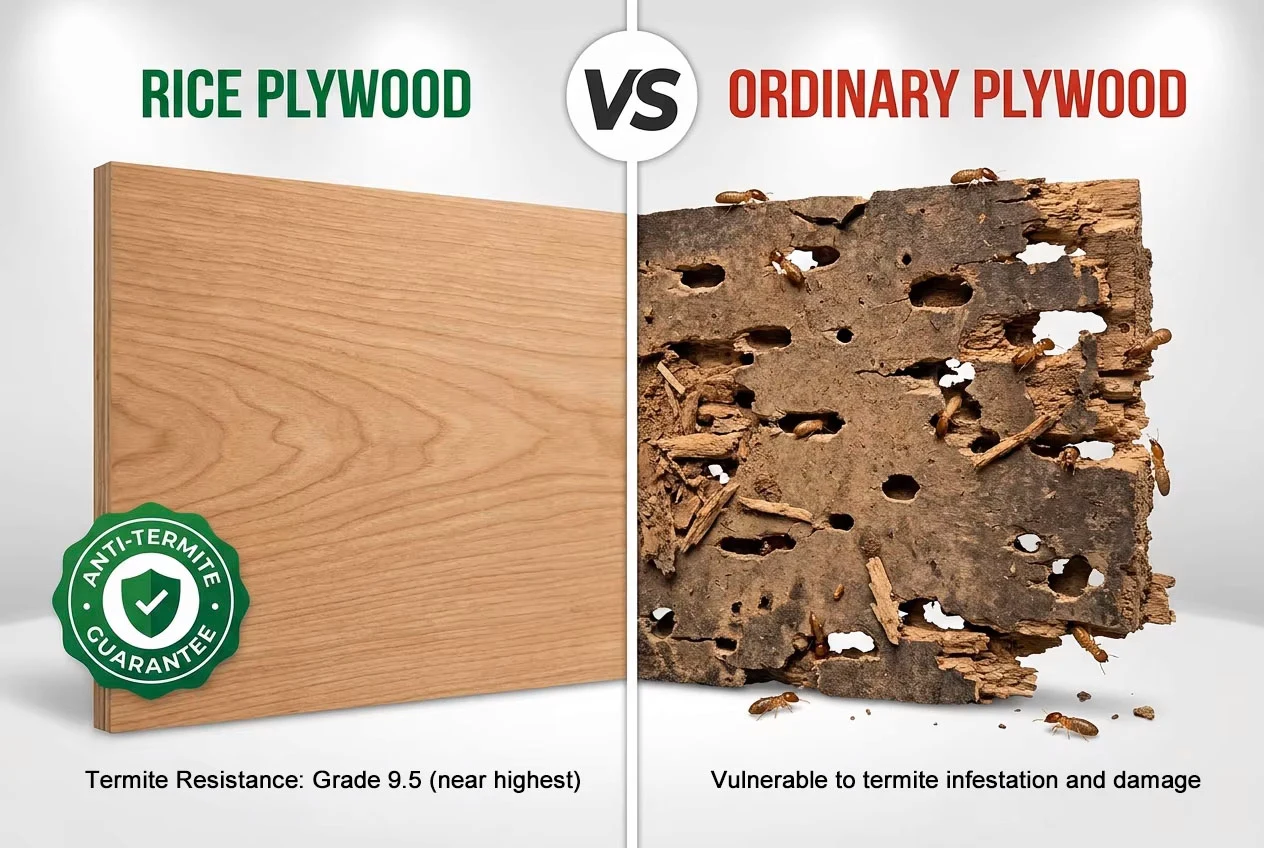
Resistenza alle termiti di grado 9.5: i tradizionali pannelli in resina urea-formaldeide sono leggermente acidi, il che li rende ideali per le termiti. Le fibre di legno forniscono inoltre un'ampia fonte di cibo per le termiti, aumentando significativamente la probabilità di infestazione. Tuttavia, la colla di riso glutinoso, dopo l'indurimento, crea un ambiente alcalino, mentre le termiti e gli insetti preferiscono un ambiente acido. In combinazione con la sua elevata permeabilità, le termiti ingeriscono parte della colla di riso glutinoso insieme alle fibre di legno. La natura alcalina della colla è indigeribile, causando la morte.
- 7. Aanti-invecchiamento, resistente alle crepe
Resistenza alle crepe e anti-invecchiamento di Classe V: il tradizionale adesivo a base di resina urea-formaldeide, derivante dalla reazione chimica tra urea e formaldeide, ha una struttura altamente instabile. Indipendentemente dalle condizioni ambientali, subisce una reazione inversa e si decompone (questa reazione è aggravata da temperature e umidità elevate), rilasciando formaldeide nell'adesivo. Pertanto, i pannelli in urea-formaldeide invecchiano continuamente e sono soggetti a crepe. Al contrario, l'adesivo a base di riso glutinoso è estremamente stabile dopo la polimerizzazione. La sua struttura cristallina polimerizzata è eccezionalmente resistente e indeformabile; la Grande Muraglia, rimasta in piedi per un anno intero, ne è la migliore dimostrazione. In combinazione con un periodo di polimerizzazione prolungato di 15 giorni, il compensato con colla di riso glutinoso presenta un coefficiente di dilatazione e contrazione termica molto basso, con conseguente resistenza alle crepe e proprietà anti-invecchiamento superiori.
- 8. B1 Ritardante di fiamma
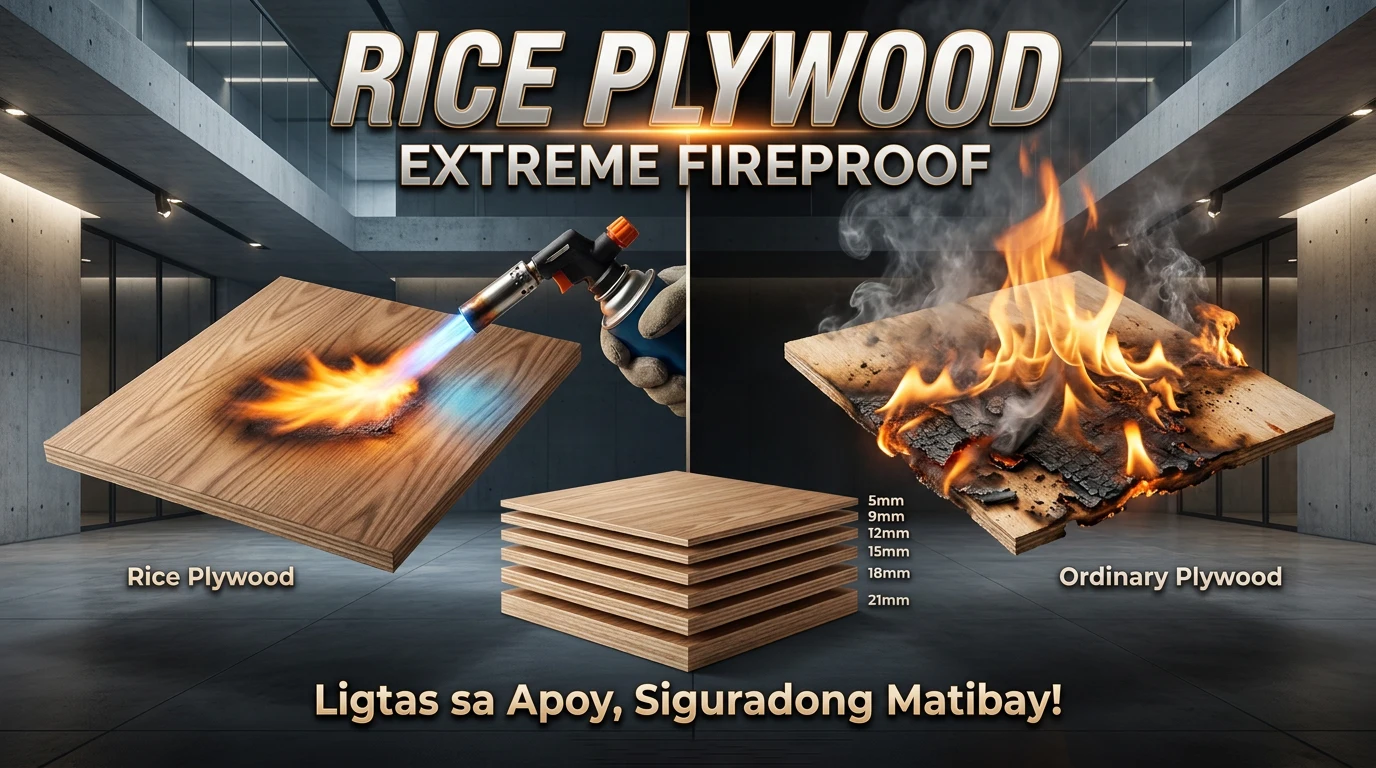
Poiché l'ossido di magnesio è un agente super ignifugo e termoisolante, con un punto di accensione che raggiunge i 2852℃, l'aggiunta di ossido di magnesio alla colla di riso glutinoso Lingmei, insieme alla densa struttura cristallina che si forma dopo l'indurimento della colla, impedisce all'aria di entrare in contatto con le fibre di legno. Anche se bruciata per diverse ore, si carbonizzerà soltanto e non brucerà.
- 9. Hcibo e isolamento acustico
L'ossido di magnesio è un eccellente agente isolante termico e acustico. La sua aggiunta conferisce al pannello prestazioni di isolamento termico estremamente elevate. Allo stesso tempo, fa sì che la colla di riso, dopo la polimerizzazione, formi una struttura cristallina densa, che migliora notevolmente le prestazioni di isolamento acustico del pannello multistrato e soddisfa persino gli standard dei materiali compositi fonoassorbenti. Le sue prestazioni di isolamento termico e acustico offrono ai clienti un'esperienza di risparmio energetico ottimale. Non ci sono zone morte calde o fredde all'interno e la temperatura percepita è più costante e confortevole. Allo stesso tempo, l'efficace strato isolante mantiene la temperatura della parete interna più vicina alla temperatura ambiente, evitando così problemi di condensa e muffa causati dalle pareti fredde.
Scenari applicativi del compensato di Qiangyi realizzato con colla di riso glutinoso.
- 1. Camere dei bambini/Sale per l'allattamento
Prodotti adatti: armadi, scrivanie, tatami, mobili per giocattoli.
Rispondere alle principali problematiche: i bambini hanno un sistema immunitario debole, sono sensibili alla formaldeide, sono spesso attivi e le superfici e i tavoli sono soggetti a versamenti d'acqua.
Corrispondenza delle prestazioni: Livello 2 impermeabile, le macchie d'acqua possono essere pulite con una semplice passata; Livello 0 antimuffa e antibatterico, aiuta gli spazi puliti a resistere ad ambienti umidi, antimuffa e antibatterico > 99%; Super ENF Grade senza formaldeide aggiunta, rilascio di formaldeide inferiore a 0,005 mg/m³

- 2. Soluzione completa per la cucina
Prodotti applicabili: mobili da cucina, pensili, banconi da bar
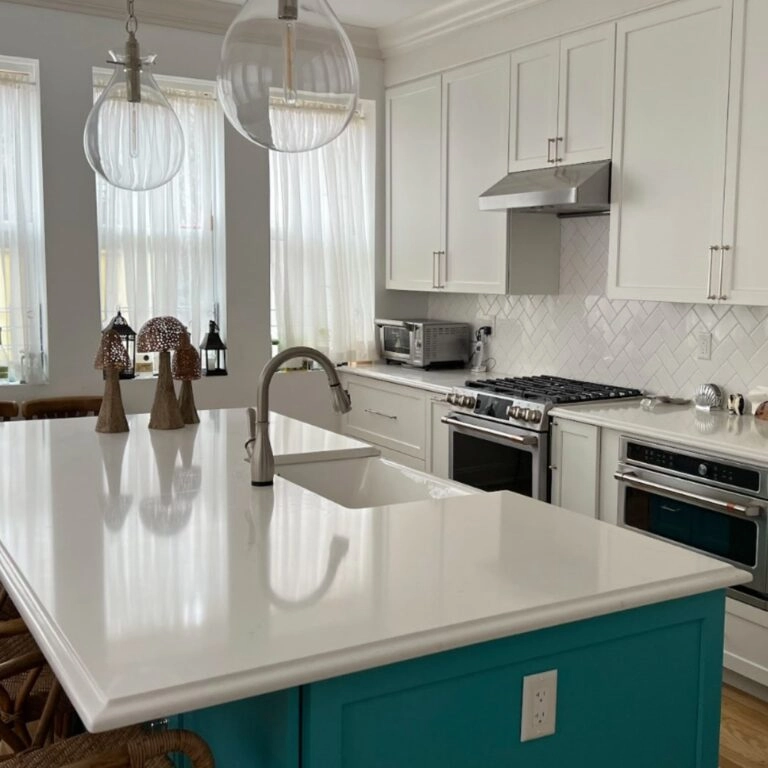
Rispondere alle principali problematiche: predisposizione alla formazione di muffa, scarsa capacità portante dei pensili, aree soggette a macchie d'olio, suscettibilità all'umidità e tendenza a creparsi.
Corrispondenza delle prestazioni: la colla di riso glutinoso forma uno strato naturale impermeabile all'umidità, prevenendo la formazione di muffa sul pannello posteriore del mobile; Capacità di tenuta dei chiodi: il compensato di colla di riso glutinoso ha una resistenza di 2040 MPa, superando di gran lunga i normali pannelli multistrato e i pannelli di particelle; Proprietà antibatteriche: la struttura antimuffa e antibatterica di grado 0 contribuisce a creare uno spazio pulito non influenzato da ambienti umidi, con proprietà antimuffa e antibatteriche > 99%.
- 3. Camera da letto Mobilia
Prodotti applicabili: armadi, testiere del letto, pannelli a parete, comodini, ecc.
Rispondere alle principali problematiche: predisposizione alla formazione di muffa, scarsa capacità di carico dei ripiani, sensibilità all'umidità, scarsa tenuta dei chiodi e facile deformazione.
Resistenza alla deformazione: compensato di colla di riso glutinoso > pannelli di particelle > pannelli multistrato ordinari;
Capacità di tenuta dei chiodi: il compensato di colla di riso glutinoso ha una capacità di tenuta dei chiodi pari a 2040 MPa;
Proprietà antibatteriche: le proprietà antimuffa e antibatteriche di grado 0 aiutano gli spazi puliti a resistere agli ambienti umidi, con attività antimuffa e antibatterica >99%;
Grado Super ENF: la colla di riso glutinoso non contiene formaldeide e le emissioni di formaldeide sono inferiori a 0,005 mg/m³.
- 4. Camera per anziani Mobilia
Prodotti applicabili: armadi, testiere del letto, pannelli a parete, comodini, ecc. Problemi principali risolti: suscettibilità alla muffa, scarsa capacità di carico dei ripiani, sensibilità all'umidità, scarsa tenuta dei chiodi, rigonfiamento a contatto con l'acqua e rumorosità.
Prestazioni ottimali: il robusto isolamento acustico del compensato di colla di riso glutinoso protegge il sonno degli anziani; Grado Super ENF: la colla di riso glutinoso non contiene formaldeide e il rilascio di formaldeide è inferiore a 0,005 mg/m³.
- 5. Mistituzioni mediche e di assistenza agli anziani
Prodotti applicabili: armadi, pareti con testiera del letto, pannelli a parete, comodini, banconi reception, banconi bar, ecc.
Rispondere alle principali problematiche: reparti ospedalieri, dove i pazienti presentano le minori difese immunitarie; case di riposo, dove gli anziani risiedono a lungo termine. La scelta del compensato di colla di riso glutinoso dimostra il rispetto dell'organizzazione per la vita ed è una scelta saggia in termini di gestione del rischio.
Corrispondenza delle prestazioni: Resistenza alla muffa di grado 0, tasso antibatterico > 99%; Sicurezza al primo posto: Ritardante di fiamma di grado B1, tempo di evacuazione prezioso in caso di calamità; Super ENF Grado
- 6. Freddo estremo spazio meteorologico
Scenari di applicazione: riscaldamento a pavimento per ambienti, rivestimenti per celle frigorifere, imballaggi per la logistica della catena del freddo, hotel e pensioni in regioni ad alta quota e fredde.
Affrontare le problematiche principali: Fragilità a bassa temperatura: i pannelli ordinari diventano fragili e soggetti a crepe al di sotto di -5℃; Dilatazione e contrazione termica: gli interruttori del riscaldamento a pavimento causano forti sollecitazioni termiche a causa delle differenze di temperatura; Fessurazioni da essiccazione: in inverno, quando l'umidità è inferiore al 20%, i pannelli perdono umidità e si restringono.
Corrispondenza delle prestazioni: Stabilità: Dopo la polimerizzazione, la colla di riso glutinoso al magnesio forma una struttura cristallina densa che organizza efficacemente il contatto tra le molecole d'acqua e l'ambiente esterno, mantenendo il contenuto di umidità interno del pannello entro i limiti ottimali e riservando uno spazio tampone per l'asciugatura; Resistenza alla deformazione: La posa simmetrica multistrato consente un rilascio uniforme delle tensioni interne.
- 7. Spazio ad alta temperatura
Scenari di applicazione: verande, armadi per finestre a bovindo, balconi su misura, mobili che circondano i fornelli della cucina, magazzini nelle regioni meridionali senza aria condizionata, officine.
Rispondere alle principali problematiche: Ammorbidimento ad alta temperatura: lo strato adesivo si ammorbidisce a temperature superiori a 40℃, riducendo la capacità di carico; Rilascio accelerato di formaldeide: il rilascio di formaldeide raddoppia per ogni aumento di 10℃ della temperatura; Fessurazione ad alta temperatura: la superficie del pannello si fessura ad alte temperature.
Corrispondenza delle prestazioni: Resistenza alle crepe: la resistenza alle crepe superficiali raggiunge il livello 5; Rilascio stabile di livello Super ENF: in condizioni di alta temperatura e alta umidità, il rilascio di formaldeide dal circuito stampato non aumenterà quasi per nulla.
- 8. Sfida di asciugatura
Scenari di applicazione: soluzioni personalizzate per l'intera abitazione in regioni aride, ambienti d'ufficio climatizzati con umidità costante durante tutto l'anno (30-40%) e ambienti a bassa umidità come officine e laboratori di elettronica.
Affrontare le problematiche principali: Contenuto di umidità sbilanciato: le variazioni del contenuto di umidità del pannello provocano restringimento e fessurazioni; Fessurazioni delle giunzioni: le fessure si formano facilmente tra i pannelli.
Corrispondenza delle prestazioni: Controllo dell'acqua: Dopo la polimerizzazione, la colla di riso glutinoso al magnesio forma una struttura cristallina densa, che impedisce efficacemente alle molecole d'acqua di entrare in contatto con l'ambiente esterno, mantenendo il contenuto di umidità interna del pannello entro l'intervallo ottimale; Resistenza alle crepe: La resistenza alle crepe superficiali raggiunge un livello elevato.
Rapporto di prova di compensato di colla di riso glutinoso Qiangyi
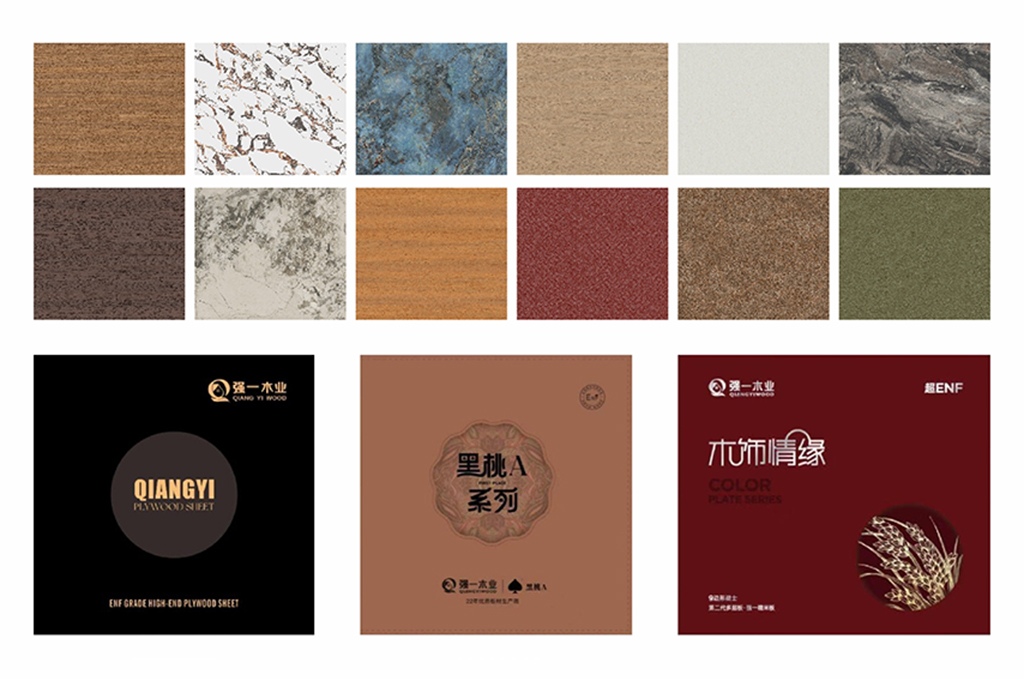
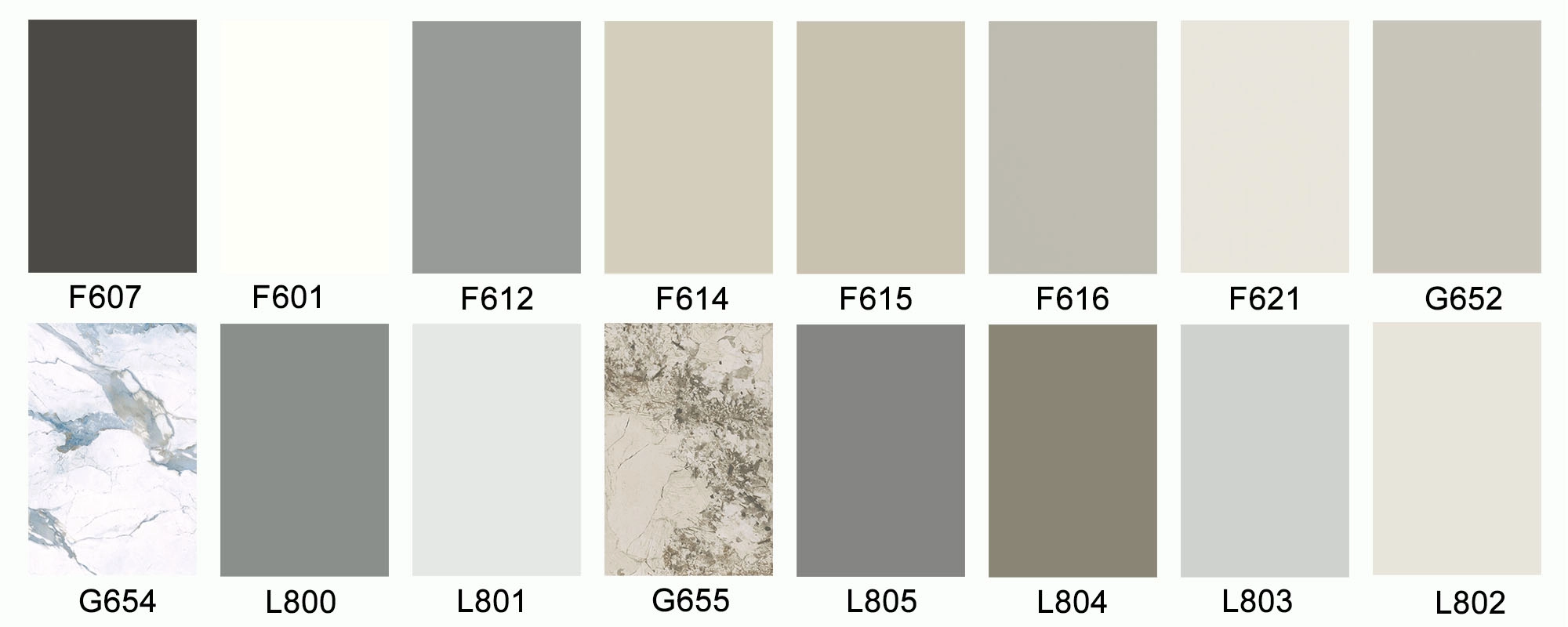
Oltre 1.000 colori tra cui scegliere
superficie in compensato
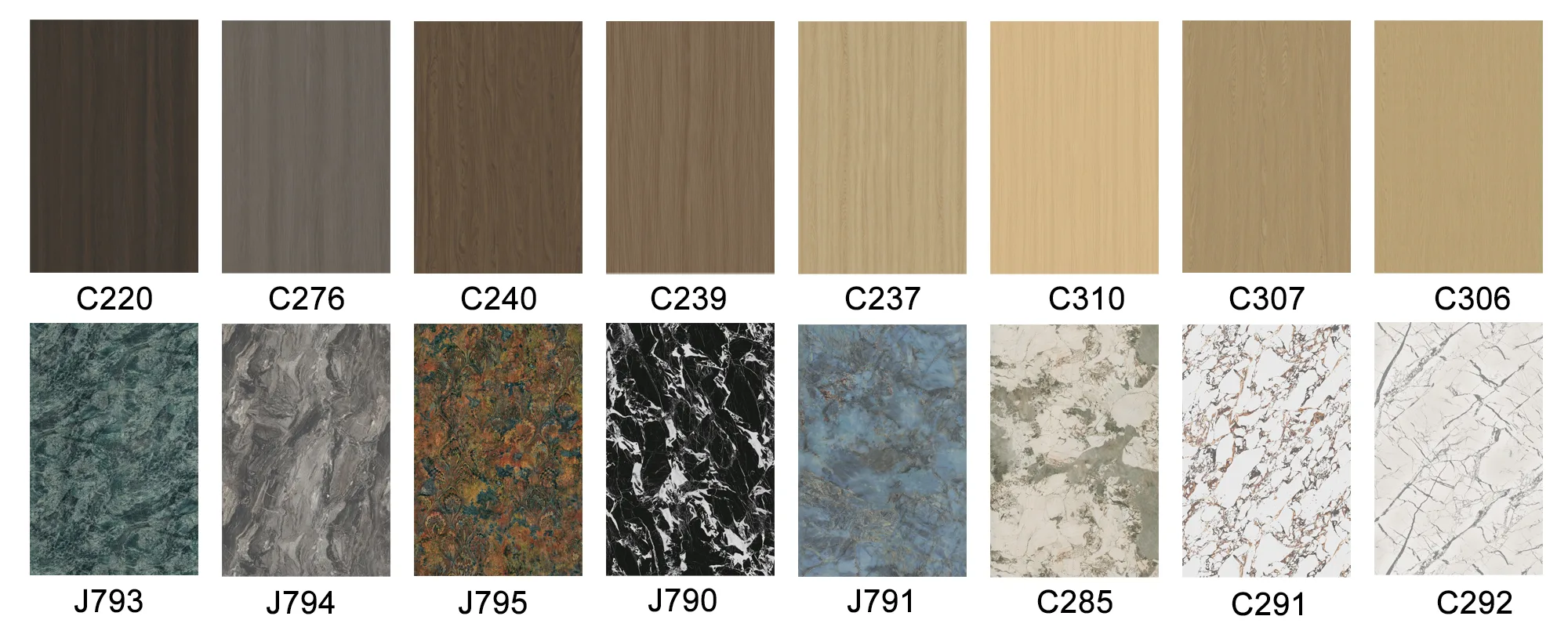
Il rivestimento superficiale del compensato isola efficacemente dall'umidità, prevenendo deformazioni, delaminazione e formazione di muffa. Migliora inoltre la resistenza all'usura, ai graffi e alla corrosione, proteggendo da insetti e danni ambientali. Il rivestimento migliora l'aspetto, stabilizza il colore e rallenta l'invecchiamento, prolungando complessivamente la durata e le prestazioni. Noi di Qiangyi possiamo fornire diversi materiali (rivestimento in PET e superficie melaminica) e una varietà di colori per adattarsi a diversi stili.
Viso melaminico
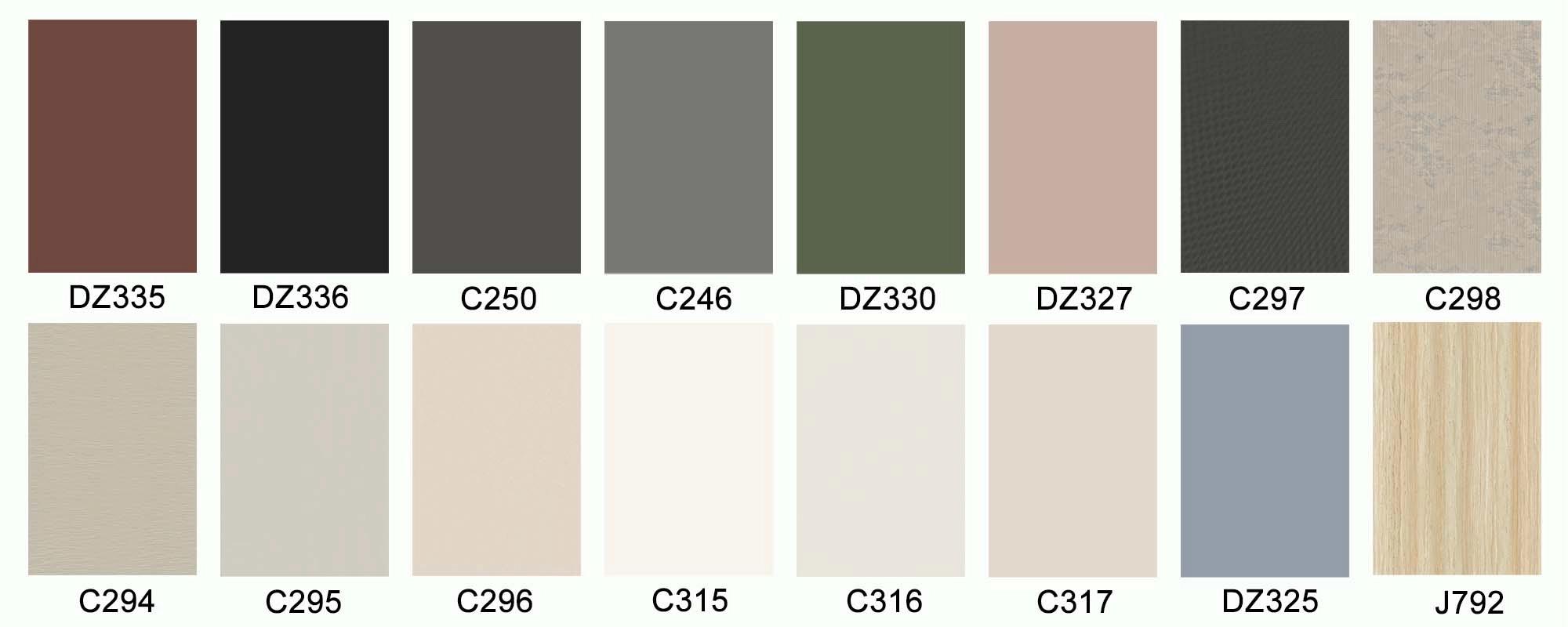
rivestito in PET
Get more information about the plywood
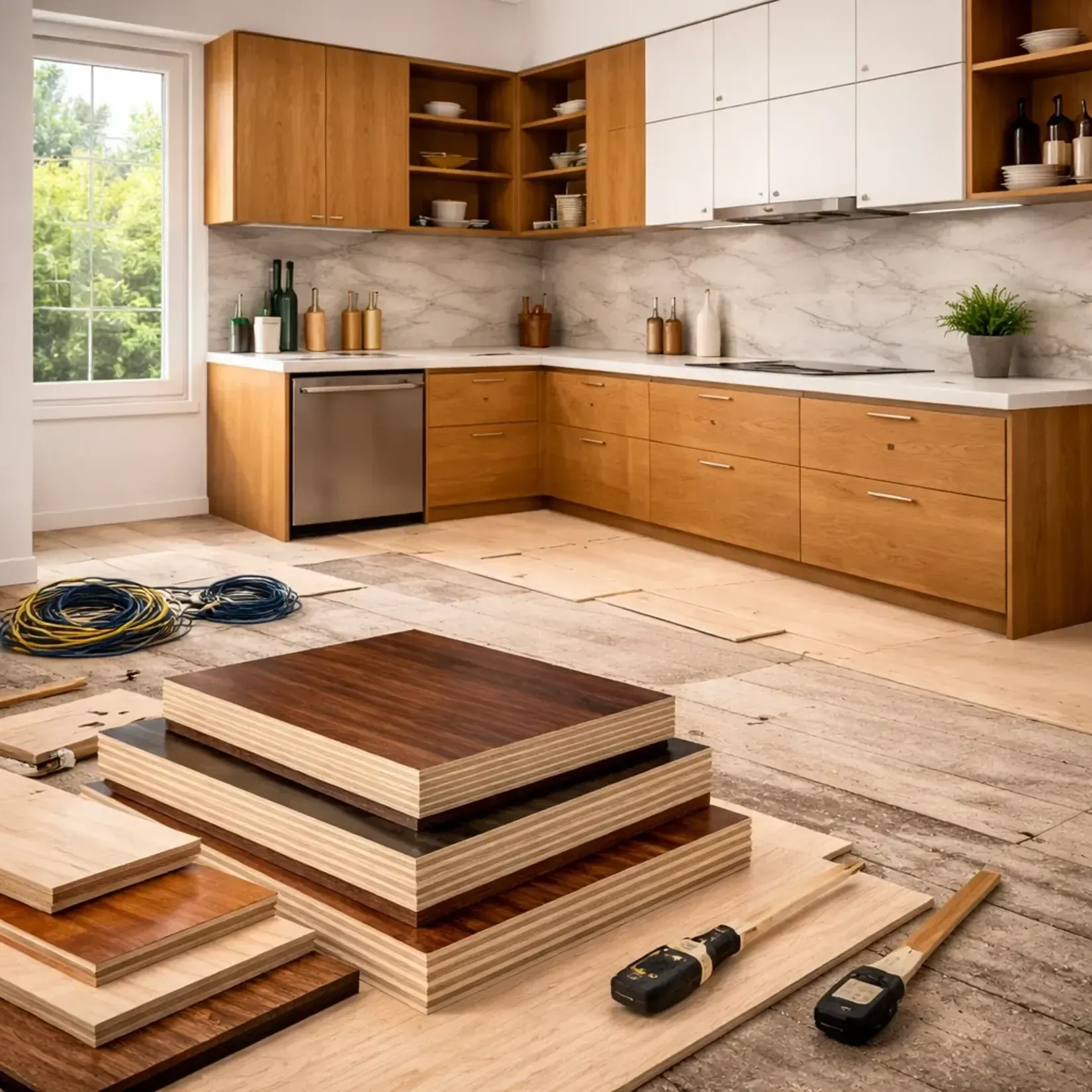
Moisture-Resistant Plywood Sourcing Guide for Sink Cabinets
A sink cabinet might leave the factory looking perfect. However, it can become a warranty issue just a few months later. A tiny plumbing leak or frequent wet cleaning can make the bottom swell. This causes the edge banding to peel up. Then, the installer has to deal with a difficult repair job. Kitchen cabinet manufacturers need to protect their finished products. They also want to avoid expensive return visits. Therefore, picking moisture-resistant plywood is not just about finding a board with a waterproof sticker. It is about true material performance. Why Sink Cabinet Swelling Creates Costly Problems for Manufacturers Below a sink, the area is exposed to a different level of moisture than a kitchen shelf. Leaks from pipes, condensation on pipes, and cleaning with wet cloths can cause panels to swell, resulting in unsightly cabinets and poorly fitting parts that need to be reworked and after-sales claims. Instead of relying on a “waterproof” label, when you select materials for projects, you should test how a panel’s bonding and core will react to moisture-related swelling. Problems with cabinets often start where you can’t see. Where Moisture Damage First Appears in Sink Cabinets Picture a rental unit where a loose drain drips water onto the bottom board. The puddles hide behind tall cleaning bottles. They stay there unnoticed for many weeks. In a different house, sweat builds up on a cold water pipe. That moisture soon trickles down into a bare, unsealed hole. The weakest spots are normally the bottom floor, the pipe cutouts, the back corners, and the seams by the floor base. Once a cut side gets thicker from water, problems happen. Even a perfectly fine surface layer will not sit flat anymore. How Swollen Panels Lead to Rework and Warranty Claims Fixing a puffed-up bottom board is rarely an easy swap. The repair worker might have to detach the pipes first. They also need to pull out shelves and cut down nearby parts. This means planning a whole new trip to the house. In custom kitchens, close cabinets and heavy countertops block easy access. The factory ends up paying for the extra labor, travel, and time. Meanwhile, the homeowner only sees a poorly made product. Just one bad piece of wood can change a good sale into a messy warranty fight. Why Ordinary Sink Cabinet Panels Swell Despite Surface Protection A shiny top layer can block normal water splashes. However, that surface is just one piece of the whole cabinet board. Water can still find a way inside the wood. Water Enters Through Cut Edges and Plumbing Openings Workers must cut holes in the sheet for a sink waste pipe. That newly exposed inner wood does not have the original factory coating. If the hole stays bare, water will soak right into the wood fibers. This makes the board swell up and get thicker. Loose edge strips, badly covered screw holes, and trapped water on the bottom floor create similar trouble. Adding a plastic drip pan and sealing every gap helps a lot. Still, those steps cannot make up for bad glue inside the actual board. Why Ordinary Plywood and MDF Respond Differently to Moisture MDF is made from tightly pressed wood dust. It gives a very smooth painted finish. However, the open sides can puff up terribly when they get wet. Plywood uses glued layers of real wood. Its reaction to water depends largely on the wood type, the chosen glue, and how it was pressed together. This fact is vital when you compare marine plywood vs ordinary plywood. The simple name tag cannot prove how a specific panel will act after getting wet. Buyers need to look at actual testing facts and the building method. They should never guess that every plywood or MDF item will perform the same way. How to Select Moisture-Resistant Plywood for Sink Cabinets A good sink-base plan must look at the inside of the board. It also needs to protect the fresh cuts made during the building process. Prioritize Water-Resistant Bonding and Core Integrity Always ask your sellers about the glue used on the wood layers. Find out if the middle part has overlapping bits, empty holes, or weak joints. A solid, smooth core makes cutting and screwing much more reliable. An immersion-peeling test reveals if the glue holds up under specific wet situations. Meanwhile, a thickness-swelling test checks a totally different factor. For a massive kitchen project, try using a basic checking method: *Look closely at the cut sides to spot any empty core gaps. *Make sure the immersion-peeling report matches the exact board you buy. *Do a quick test run to seal the edges around pipe holes. Check Thickness, Edge Protection, and Purchase Specifications People looking for plywood thickness for cabinets usually want 18 mm boards. Yet, the best size truly depends on the cabinet shape, the total weight, and the metal hinges. The kitchen cabinet plywood thickness must be chosen along with the core style, layer setup, top color, and edge tape. Clearly demand waterproof sealant around pipe gaps, the bottom borders, and any fresh cuts. Think about homes near the sea or floors that get mopped daily. For these spots, you must also check airflow and ways to reach leaks easily. No thick board can ever replace smart building designs. How QIANGYI PLYWOOD Helps Reduce Sink Cabinet Swelling At QIANGYI PLYWOOD, we tackle water threats using a clean, water-blocking glue mix. We also use a full-eucalyptus core layout. This special design stops empty pockets inside the wood. We do not just count on a pretty top color for protection. Glutinous Rice Glue Supports Moisture-Resistant Bonding Our glutinous rice glue plywood relies on Lingmei adhesive. This unique glue is mixed from glutinous rice starch, magnesium chloride, magnesium oxide, and pure water. The wet glue sinks deep into the tiny holes of the wood fibers. Once it dries, it builds a tight, super-strong connecting web. The final plywood is built to reach ENF-grade ultra-low formaldehyde emissions. At the same time, it keeps its tough, water-resistant bond. We spread the glue smoothly on every single layer. Next, we apply 24 hours of cold pressing at normal room temperature. We dry it carefully to hit the right moisture level. Finally, we let it rest and settle properly. This careful routine keeps the glue quality steady across all factory runs. It fights off swelling from random spills or damp room air. It also greatly lowers the chance of the wood layers peeling apart from water damage. Eucalyptus Core and Fully Core-Connected Construction Improve Panel Stability Picking the right middle wood is just as crucial. We use a full eucalyptus core for this special glutinous rice plywood. We never use a random mixed-wood core. The inner sheets are laid out using fully core-connected construction. This means the middle pieces fit tightly together to stay solid. It prevents silly gaps inside the board. This detail is huge when workers drill pipe holes or screw the cabinet walls together. Hidden weak spots can easily break a cabinet. Using strong eucalyptus wood and smooth glue layers ensures a steady, tough product. Even with this strong build, you still must seal the cut edges. Test Evidence and Procurement Value for Sink Cabinet Manufacturers Smart buyers require real proof of strong glue, anti-swelling power, and good factory support. Class II Water Resistance and Immersion-Peeling Test Results An official immersion-peeling test report, No. SZF-WT-25101715-03, shows six tested pieces. It confirms a perfect 100% pass rate and a fully compliant score. The Class II test rules demand soaking the wood in hot water at 63°C ± 3°C. This great score proves it handles wet conditions well. However, it is not meant to stay underwater forever. We also provide a Waterproof and Anti-Swelling Responsibility Commitment. This paper covers valid edge-swelling and glue-failure problems after the setup is done. Buyers should always check these rules to match their specific orders and plans. Hour Immersion Results and Real-World Sourcing Value A different 72-hour soaking test looks at three distinct boards side by side. The recorded thickness shifts are: Material Before soaking After 72 hours Increase Glutinous rice glue plywood 18.20 mm 18.35 mm 0.15 mm Ordinary plywood 18.13 mm 19.05 mm 0.92 mm MDF 18.30 mm 20.66 mm 2.36 mm The tiny size change shows the true worth of a stable board. Puffed-up edges make fixing cabinets very hard. Of course, this basic test does not replace official batch checks. In the very damp Philippine market, a wood panel seller first tried one color of our glutinous rice glue plywood. They loved it, bought much more, and added new colors later. This story shows strong buyer interest. It does not measure exact sink-cabinet lifespans, though. Before you order a massive batch, always check the samples, exact rules, test papers, and return policies. We can chat about all these facts at THE 2026 GUANGXI INTERNATIONAL FOREST PRODUCTS AND WOOD PRODUCTS EXHIBITION. Find us at Booth D5T-06, Nanning International Convention & Exhibition Center, from November 21–23, 2026. FAQ Q: Is your plywood made with a full eucalyptus core or a combi core? A: Our glutinous rice glue plywood relies on a full eucalyptus core. It features fully core-connected veneer construction. Cabinet makers should double-check the exact core details when asking for samples or price lists. Q: Why does plywood swell around kitchen sink plumbing cutouts? A: Drilling pipe holes chops up the wood fibers. It strips away the safe outer layer. Tiny pipe drips, or cold-water sweat can easily soak into those raw cut walls. When the wood drinks that water, the edges puff up. This pushes against the edge tape and can ruin the nice outer finish. Q: Is your glutinous rice glue plywood waterproof or marine grade? A: Our board has passed the Class II water-resistance tests under strict national rules. It is built for very damp indoor rooms. This includes kitchen sink cabinets, bathroom units, and beachside houses. It fights off daily splashes and damp swelling brilliantly. Still, you must never leave it sitting deep underwater for long periods. Q: How can cabinet manufacturers verify anti-swelling performance before bulk purchasing? A: You should look at a real sample. Check the immersion-peeling scores and the thickness-swelling proof. Review the inner core style and the promised inspection rules. The test papers must clearly match the exact wood you are buying. Q: Does moisture-resistant plywood still require edge sealing in sink cabinets? A: Yes, it absolutely does. You must seal all fresh cuts, pipe gaps, and weak joints. Also, fix any water leaks right away. Tough glue and smart building habits work perfectly together. They stop silly cabinet failures from happening.
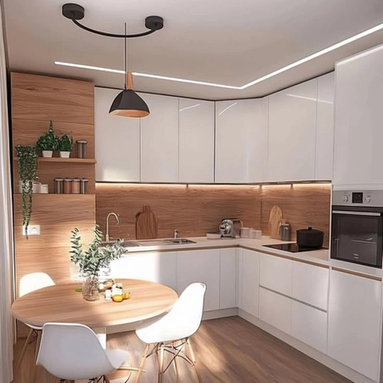
Anti-Mold Plywood Checklist for Hotel Furniture Buyers
Mold in hotel furniture rarely begins as a dramatic leak. More often, it starts behind a wardrobe, under a vanity, beside a cold wall, or along an exposed panel edge that stays damp. The board may look fine at delivery, while moisture-related defects appear months later. A useful anti-mold plywood checklist therefore has to look beyond one label. Buyers need to evaluate the environment, core structure, bonding system, moisture control, and test evidence before approving a bulk order. Where Do Mold Problems Start in Hotel Furniture Projects? Hidden Moisture Zones in Guestroom Furniture Hotel rooms create several moisture conditions in one small space. A wardrobe fixed against an exterior wall may receive little airflow. A bathroom vanity sees splashes, steam, and repeated cleaning. A minibar cabinet can sit near cool surfaces where condensation forms. In tropical or coastal hotels, rooms closed between guests may also stay humid for long periods. Panel edges, drilled holes, backs, joints, and internal layers can take in moisture before the decorative face shows obvious damage. Why a Small Mold Spot Can Become a Project Cost In a hotel, one material specification may be repeated across dozens or hundreds of rooms. A local defect can therefore become room downtime, replacement furniture, another installation visit, delayed handover, warranty claims, and complaints from the operator. Anti-mold performance is not only an appearance issue. For a hotel furniture buyer, it is part of project risk control. Why Does Plywood Develop Mold and Moisture-Related Damage? Humidity, Condensation, and Slow Drying Create the Risk Mold needs favorable moisture conditions. Furniture becomes more vulnerable when humidity remains high, water enters through unfinished edges, or condensation repeatedly wets a cold surface. The problem is often cumulative. A panel takes in some moisture, dries slowly, then repeats the cycle. Poor airflow behind fixed furniture can make this worse. Anti-mold material cannot replace leak repair, ventilation, or humidity control, but it can give the furniture assembly a better margin against these conditions. Moisture Can Also Lead to Swelling and Deformation Moisture can also stress the glue line, swell wood fibers, loosen fastening areas, or change panel flatness. A board used for wardrobes, vanity units, headboards, or built-in cabinets therefore needs a stable core and reliable bonding. Even when buyers search for plywood thickness for cabinets, thickness alone cannot compensate for internal gaps, weak veneers, or a moisture-sensitive structure. What Should Hotel Buyers Check Before Approving Anti-Mold Plywood? The supplier should be able to explain how the panel is built and how it performs. The phrase waterproof plywood is not enough, and neither is a general “mold resistant” claim. Buyer Check Why It Matters Mold or mildew resistance evidence Confirms the anti-mold claim Antibacterial performance Adds hygiene-related evidence Core species and grade Affects stability and fastening Full-connected core structure Reduces internal weak points Panel moisture content Checks moisture control before shipment Water-resistance and bond test Checks glue-line integrity after moisture exposure Edge sealing plan Helps limit moisture entry after fabrication Verify the Structure, Not Just the Surface For hotel furniture, eucalyptus core board construction is worth checking at the exposed edge or approved sample. A hardwood core can support repeated fastening and daily use, but the species name alone is not enough. Buyers should ask whether the core is continuous and whether gaps, overlaps, or filler veneers are present. Cabinet grade plywood should be judged as a complete structure, not only by face appearance. Match the Board to the Furniture Location The risk level differs by application. A wardrobe on an internal dry wall is not exposed like a vanity beside a shower area. A tall cabinet door also places more emphasis on flatness and deformation control. For bulk hotel projects, approve the panel by application: wardrobe, vanity, minibar, wall panel, or other built-in furniture. How Does QIANGYI PLYWOOD Target Moisture-Driven Mold Risk? At QIANGYI PLYWOOD, we approach the problem through the core, adhesive system, and moisture-control process rather than relying on a surface claim alone. Full Eucalyptus Core and Full-Connected Core Construction We use full eucalyptus core options built with continuous eucalyptus veneers. In this structure, full-connected core means the internal veneers are arranged without voids, overlaps, or dead joints. The aim is a more uniform panel with fewer internal weak points. We use 100% eucalyptus core solutions for cabinet and furniture applications. For hotel wardrobes and tall cabinet panels, this matters because core continuity supports more consistent machining, fastening, and dimensional stability. It also gives buyers something practical to inspect on a cut edge before bulk approval. Glutinous Rice Glue Helps Create Less Favorable Conditions for Mold Our Lingmei glutinous rice glue uses glutinous rice flour, magnesium chloride, water, and magnesium oxide. The magnesium components react to create an alkaline environment. More importantly for hotel furniture buyers, an antibacterial and mildew-proof test conducted according to JC/T 2039-2010 on an 18 mm glutinous rice glue multifunctional board recorded an antibacterial rate above 99% and a Grade 0 mildew-proof rating. Under the test rating criteria, Grade 0 means no mold growth was observed. For buyers, this provides direct test evidence for evaluating mold and bacterial resistance instead of relying only on a general anti-mold claim. The adhesive system, moisture control, and tested resistance work together to reduce mold-related risks in furniture exposed to humid conditions. Controlled Drying Keeps Panel Moisture in the 8–12% Range We use a 60-hour temperature-controlled drying process and control board moisture content within 8–12%. This reduces excess moisture before furniture production and supports more stable use in humid conditions. For projects involving humid storage, long shipping routes, or air-conditioned guest rooms, starting with controlled panel moisture is more practical than correcting unstable boards after machining. What Evidence Should Hotel Buyers Put in the Approval File? Testing should support the purchase decision, especially when anti-mold performance is part of the hotel furniture specification. Report No. HJ-RD-26150 covers antibacterial and mildew-proof testing of an 18 mm glutinous rice glue multifunctional board according to JC/T 2039-2010. The tested sample achieved an antibacterial rate above 99% and a Grade 0 mildew-proof rating. The report defines Grade 0 as no mold growth. The antibacterial test used Escherichia coli AS1.90, while the mildew-resistance evaluation included multiple fungal species. For a hotel furniture buyer, this provides direct evidence related to the actual risk being evaluated: whether the panel can resist bacterial growth and mold development under the specified test conditions. For a hotel project, the approval file should include: Core species and full-connected-core confirmation. Antibacterial and mildew-proof test results. The applicable test standard and tested panel specification. Panel moisture specification and moisture-resistance information. Approved thickness, face finish, and edge treatment. A production sample matching the bulk order. These checks make later quality discussions easier because the approved panel has a defined structure and performance basis. Practical Case: Plywood Sourcing for a Humid Philippine Market In early 2026, a Philippine decorative panel and furniture-material distributor contacted us while comparing suppliers for a hot, humid market. The buyer was particularly concerned about environmental performance, moisture resistance, and durability. After seeing our glutinous rice glue plywood in person, the distributor placed a trial order in April with one color. The first shipment received positive market feedback for its ENF grade, surface texture, waterproof performance, and termite resistance. Demand soon expanded beyond the original color, so we developed a customized color sample book for the buyer. The distributor later introduced more finishes through its offline showroom and positioned the glutinous rice glue plywood as a premium product line. For hotel and furniture buyers, this case shows why humid-market sourcing should consider moisture-related performance, structural stability, and consistent product presentation. Meet Us in Guangxi International Forest Products and Wood Products Exhibition For buyers currently sourcing plywood for hotel furniture or other commercial projects, we will attend THE 2026 GUANGXI INTERNATIONAL FOREST PRODUCTS AND WOOD PRODUCTS EXHIBITION from November 21–23, 2026. Visitors can meet our team at Booth D5T-06 at the Nanning International Convention & Exhibition Center to discuss anti-mold plywood, eucalyptus core, full-connected core construction, and project-specific panel requirements. FAQ Q: What is anti-mold plywood for hotel furniture? A: It is plywood selected to reduce mold-related risk in humid interior furniture. Buyers should check mold resistance together with moisture control, bond quality, core continuity, and dimensional stability rather than relying on one anti-mold label. Q: Is anti-mold plywood the same as waterproof plywood? A: No. Water resistance focuses on moisture exposure, bonding, and swelling. Anti-mold performance focuses on resistance to fungal growth. The two properties support each other, but they are not the same test. Q: Why is a full eucalyptus core important for hotel cabinets? A: A full eucalyptus hardwood core provides a dense, consistent base for furniture use. When combined with a full-connected core structure, it also reduces concerns about internal voids, overlaps, and weak joints. Q: Where should mold-resistant plywood be prioritized in a hotel? A: High-risk locations include bathroom vanities, wardrobes against exterior walls, minibar cabinets, lower cabinet panels, and furniture in tropical, coastal, or poorly ventilated rooms. Q: What should buyers request before placing a bulk anti-mold plywood order? A: Request the approved core structure, panel moisture range, antibacterial and mildew-proof test results, applicable test standard, tested panel specification, thickness and surface requirements, and a production sample that matches the final order.
Guida al compensato antitermite per ridurre le richieste di garanzia
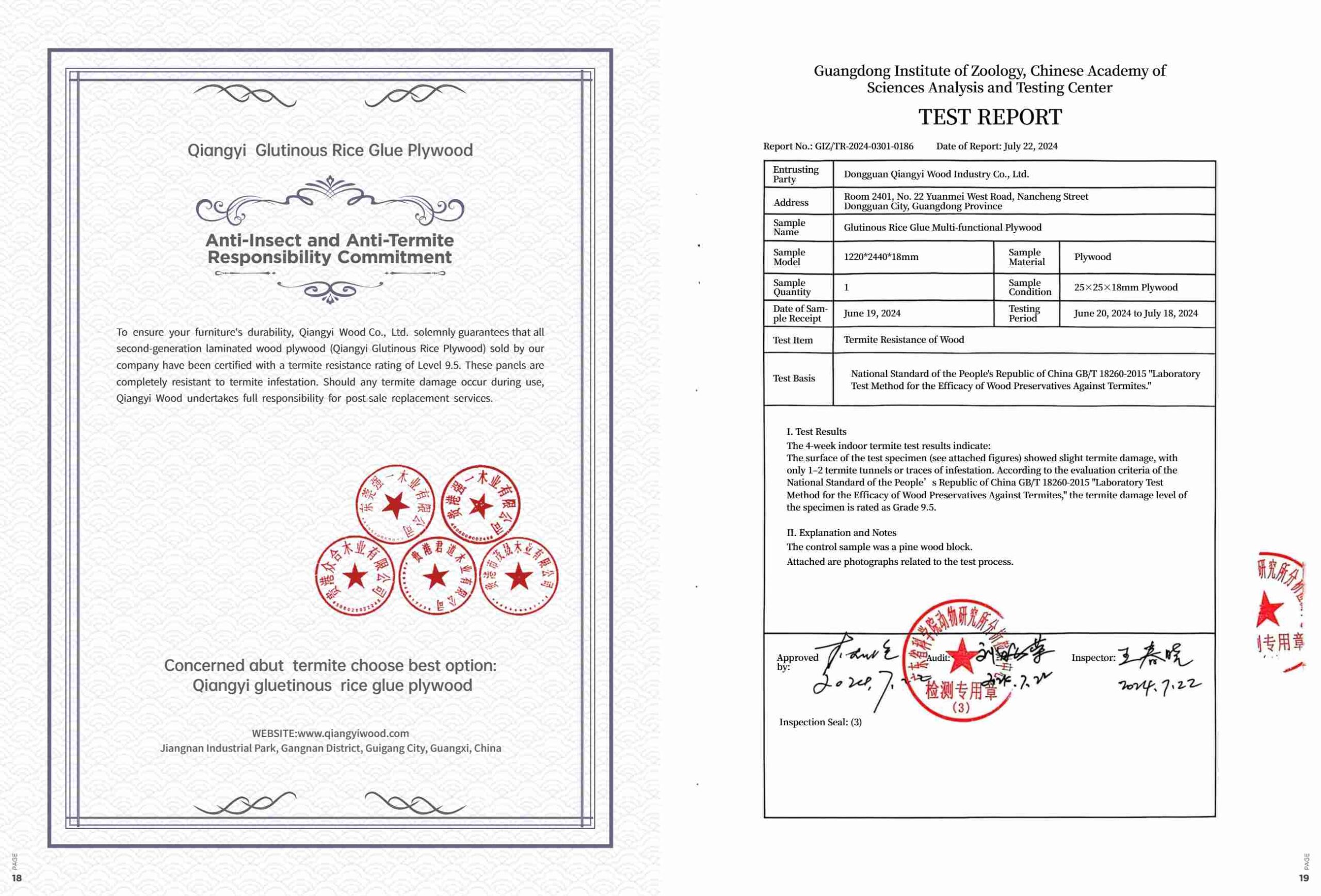
Un problema di termiti in un mobile finito raramente rimane un piccolo danno materiale. Una volta installato un armadio, un mobile da cucina o un elemento a incasso, i danni possono comportare ispezioni in loco, sostituzione dei pannelli, costi di manodopera e trasporto, e controversie sulla garanzia. Ecco perché il compensato resistente alle termiti dovrebbe essere valutato prima di iniziare il taglio. Per i produttori di mobili, la vera questione non è se un pannello riporti un'etichetta antitermite, ma se l'anima, il sistema adesivo, la struttura del pannello e le prove di collaudo supportino una strategia di garanzia a basso rischio. Perché i danni causati dalle termiti si trasformano in costose richieste di risarcimento in garanzia per i mobili della cucina? I danni nascosti spesso emergono dopo l'installazione. Le termiti possono penetrare attraverso passaggi nel terreno, crepe nei muri, tubature o legno e imballaggi infestati. Nei progetti di falegnameria, le aree difficili da vedere includono i pannelli posteriori vicino alle pareti, gli zoccoli, le basi degli armadi e i mobili sotto il lavello. Il compensato può apparire normale durante la produzione. I danni potrebbero diventare visibili solo dopo l'installazione dei mobili, quando il produttore potrebbe dover ispezionare il sito, smontare i mobili, riprodurre i pannelli, spedire i pezzi di ricambio e organizzare la reinstallazione. Il costo può facilmente superare quello di un singolo pannello danneggiato. Un tipico scenario in cucina è quello di un mobile base installato vicino alle tubature in un appartamento umido. Se l'infestazione di termiti, nascosta, raggiunge il substrato, la sostituzione di un pannello interno potrebbe richiedere la rimozione di ferramenta, ante, piani di lavoro o mobili adiacenti. In un progetto di armadio, i danni dietro un pannello posteriore fisso possono passare inosservati finché il cliente non nota polvere, cavità o sezioni indebolite. L'esposizione alla garanzia inizia con la scelta del materiale. Una superficie decorativa non deve essere confusa con la protezione contro le termiti. Il compensato melaminico può offrire una finitura pratica, ma la sola superficie non garantisce che il substrato resista alle termiti. Lo stesso vale per il compensato marino laminato o per i pannelli marini. La resistenza all'umidità e la resistenza alle termiti sono due questioni distinte. Una domanda frequente da parte degli acquirenti è: "Il compensato marino laminato è resistente alle termiti?". La risposta dipende dal nucleo, dal sistema adesivo e dai risultati dei test, non dal nome del prodotto. Perché il compensato può ancora essere vulnerabile all'attacco delle termiti? Il compensato è realizzato con impiallacciature di legno, quindi la cellulosa rimane all'interno del pannello. Una superficie decorativa può proteggere la superficie durante l'uso quotidiano, ma i bordi tagliati, i fori, i punti di fissaggio e le impiallacciature interne sono comunque importanti in ambienti a rischio di infestazione da termiti. Le condizioni del progetto aggiungono un ulteriore livello di rischio. I mobili della cucina possono essere posizionati vicino alle tubature, mentre gli armadi possono rimanere fissi alle pareti per anni. Nei mercati tropicali o umidi, l'accesso nascosto e i lunghi periodi di utilizzo possono trasformare una piccola infestazione in un costoso problema post-vendita. Per questo motivo, la dicitura "a prova di termiti" non dovrebbe essere considerata una promessa illimitata. Un approccio migliore combina la selezione di pannelli adeguati con una corretta installazione, sigillatura, ispezione e misure locali di disinfestazione. Quali caratteristiche dovrebbero richiedere i produttori di mobili al compensato resistente alle termiti? Prima di confrontare i prezzi, gli acquirenti dovrebbero verificare cosa viene effettivamente fornito. Acquisto assegno Cosa confermare Prove della presenza di termiti Metodo di prova, campione, data, numero del rapporto, valutazione Materiale di base Specie legnosa e qualità dell'impiallacciatura Costruzione del nucleo Nucleo completamente connesso, non una stratificazione parziale e allentata. Specifiche dell'armadio Spessore, superficie, trattamento dei bordi, uso previsto Responsabilità del fornitore Procedura post-vendita chiara La qualità del nucleo merita particolare attenzione. Il nucleo di eucalipto è prezioso per la falegnameria perché fornisce una base in legno duro, resistente e stabile. L'eucalipto di grande diametro è considerato una materia prima per compensato apprezzata per la sua resistenza e la sua qualità stabile. Un nucleo completamente connesso, o laminazione a nucleo pieno, crea una struttura interna più controllata rispetto a un nucleo parzialmente connesso. In questa costruzione, gli strati del nucleo sono disposti in modo continuo, mentre l'adesivo viene applicato strato per strato. Nessuno dei due punti dovrebbe essere usato come sostituto del test per le termiti. Piuttosto, aiutano gli acquirenti a specificare un substrato più uniforme. Anche lo spessore del compensato per i mobili deve corrispondere al progetto effettivo. Un pannello testato da 18 mm non dovrebbe essere automaticamente considerato una prova valida per qualsiasi spessore o costruzione. In che modo QIANGYI PLYWOOD affronta il rischio di danni da termiti nei pannelli? Noi di QIANGYI PLYWOOD affrontiamo questo problema attraverso il sistema adesivo, la selezione del nucleo in eucalipto e la costruzione del nucleo completamente connesso, anziché affidarci a una semplice affermazione superficiale. La colla di riso glutinoso Lingmei agisce attraverso la struttura legata Il nostro compensato con colla di riso glutinoso utilizza la colla di riso glutinoso Lingmei, composta da farina di riso glutinoso, cloruro di magnesio, ossido di magnesio e acqua. Dopo la polimerizzazione, il cloruro di magnesio e l'ossido di magnesio creano un ambiente adesivo alcalino. Il nostro approccio tecnico consiste nel modificare l'equilibrio acido-base all'interno del legno attraverso questo ambiente adesivo alcalino, creando condizioni sfavorevoli all'attività delle termiti. Questo è importante perché la produzione di mobili comporta taglio, foratura, incernieratura e lavorazione dei bordi. ProteggiLe azioni legate al sistema di incollaggio interno sono più rilevanti per tali operazioni rispetto a una rivendicazione basata unicamente sulla superficie finita. Il nucleo in eucalipto e la stratificazione a nucleo pieno garantiscono uniformità Per le applicazioni di falegnameria, diamo particolare importanza all'anima in eucalipto di prima qualità. L'eucalipto fornisce una solida base strutturale, mentre la resistenza alle termiti deriva dall'intero sistema di pannelli testati, non dalla sola specie legnosa. Le impiallacciature sono disposte come un nucleo completamente connesso e incollate strato per strato. Questa costruzione richiede una selezione più accurata del nucleo e conferisce al pannello una stratificazione interna più uniforme. Il processo prosegue quindi con una pressatura a freddo prolungata, un'asciugatura controllata e una fase di stagionatura. La sequenza produttiva comprende 24 ore di pressatura a freddo autoriscaldante, 60 ore di asciugatura e oltre 15 giorni di condizionamento. Per le aziende produttrici di mobili, il vantaggio pratico risiede nell'uniformità tra fianchi, ripiani, ante, armadi e altri componenti. Caso di studio: Riduzione dei rischi legati alle termiti e all'assistenza post-vendita a Mauritius. Un nostro cliente di lunga data, un'azienda produttrice di mobili di Mauritius, continua a riordinare container completi di compensato di alta qualità con anima in eucalipto al 100%. Il clima locale dell'isola è umido e rigido, e i pannelli comuni possono presentare nel tempo problemi di sfogliatura, deformazione e attacco di termiti. Per questo cliente, forniamo compensato realizzato con anima in eucalipto al 100% e colla di riso glutinoso, combinato con un processo di lavorazione controllato per una maggiore stabilità del pannello. Il test di resistenza alle termiti di grado 9.5 fornisce inoltre all'acquirente una prova più chiara nella scelta dei materiali per la produzione di mobili. Secondo il cliente, l'utilizzo del nostro compensato per i mobili ha ridotto le preoccupazioni relative a problemi post-vendita. La qualità costante dei lotti aiuta inoltre la fabbrica a mantenere prestazioni di taglio, tenuta delle viti e impostazioni di produzione simili per ordini ripetuti. Che significato ha il test di livello 9.5 per gli acquisti e i rischi di garanzia? L'affermazione relativa alla resistenza alle termiti è supportata dal rapporto di prova GIZ/TR-2024-0301-0186, rilasciato dall'Istituto di Zoologia del Guangdong, Centro di Analisi e Test dell'Accademia Cinese delle Scienze. Il campione testato era un compensato multifunzionale in colla di riso glutinoso, di dimensioni 1220 × 2440 × 18 mm, e la norma di riferimento per la prova era GB/T 18260-2015. Il numero del relativo rapporto di prova per la resistenza alle termiti è inoltre indicato nei registri di prova del prodotto. Durante il test di resistenza alle termiti condotto in ambienti interni per quattro settimane, il rapporto ha registrato lievi danni da termiti, con solo uno o due tunnel o tracce di infestazione. Il campione ha ricevuto una valutazione di resistenza ai danni da termiti di grado 9,5. Il risultato di resistenza alle termiti di grado 9,5 è incluso anche nelle informazioni sulle prestazioni del pannello. Per gli acquirenti, il valore fondamentale risiede nella tracciabilità, non in una promessa assoluta. Il numero del rapporto, la composizione del campione, lo spessore, il metodo di prova e il risultato possono essere verificati e confrontati con il materiale ordinato. Questo permette inoltre agli importatori e alle fabbriche di mobili di fornire ai clienti finali prove concrete, anziché basarsi su una descrizione generica del prodotto. Una sequenza pratica per gli acquisti è la seguente: 1. Verificare se il progetto presenta un rischio significativo di infestazione da termiti. 2. Adattare lo spessore e la superficie del pannello al design del mobile. 3. Confermare l'anima in eucalipto e la costruzione dell'anima completamente connessa, ove specificato. 4. Richiedere il rapporto di resistenza alle termiti per il pannello corrispondente. 5. Conservare il rapporto e le specifiche di acquisto insieme alla documentazione relativa alla qualità del progetto. Per i progetti che utilizzano il nostro compensato di seconda generazione a base di colla di riso glutinoso, offriamo anche una garanzia contro insetti e termiti. Qualora si verificassero danni causati da termiti o insetti xilofagi nelle condizioni applicabili, ci assumiamo la responsabilità della sostituzione post-vendita. Per i produttori di mobili, questo crea un percorso di gestione del rischio più chiaro rispetto a una vaga etichetta "antitermite". Venite a trovarci alla Fiera Internazionale dei Prodotti Forestali e del Legno del Guangxi 2026. Se siete alla ricerca di compensato resistente alle termiti, compensato con anima in eucalipto o pannelli con anima completamente integrata per progetti di mobili e armadi, potete incontrare il nostro team alla Fiera Internazionale dei Prodotti Forestali e del Legno del Guangxi 2026. Saremo lieti di accogliere produttori di mobili, importatori di compensato, distributori e acquirenti di progetti per discutere di persona con noi le specifiche dei pannelli, i requisiti di resistenza alle termiti, la struttura dell'anima e le esigenze di approvvigionamento. Nome dell'evento: LA MOSTRA INTERNAZIONALE DEI PRODOTTI FORESTALI E DEL LEGNO DEL GUANGXI 2026 Numero dello stand: D5T-06 Data: 21-23 novembre 2026 Luogo: Centro Congressi e Fieristico Internazionale di Nanning FAQ D: Il compensato marino laminato è resistente alle termiti? R: Non automaticamente. Le prestazioni in presenza di umidità e la resistenza alle termiti devono essere verificate separatamente. Verificare il substrato, il sistema adesivo e il rapporto del test per le termiti. D: Il compensato melaminico è resistente alle termiti? A: Una superficie in melamina non rende di per sé il substrato resistente alle termiti. È necessario valutare anche il nucleo e il sistema di incollaggio interno. D: Perché utilizzare un nucleo di eucalipto nel compensato per mobili resistente alle termiti? A: Il nucleo di eucalipto fornisce una base strutturale forte e stabileIn questo sistema di pannelli, la resistenza alle termiti deriva dalla costruzione completa e collaudata e dal sistema adesivo. D: Cosa si intende per nucleo completamente connesso? A: Significa che le impiallacciature interne formano un nucleo continuo e compatto, anziché una stratificazione parzialmente connessa. Ciò garantisce una struttura interna più uniforme per la lavorazione dei mobili. D: Il compensato di grado 9.5 resistente alle termiti può eliminare tutte le richieste di garanzia? A: No. Le prove di grado 9.5 possono ridurre l'incertezza nella selezione dei materiali, ma la corretta specifica, installazione, gestione dell'umidità, ispezione e controllo delle termiti in loco rimangono comunque fondamentali.
B1 Guida al compensato ignifugo per ridurre il rischio
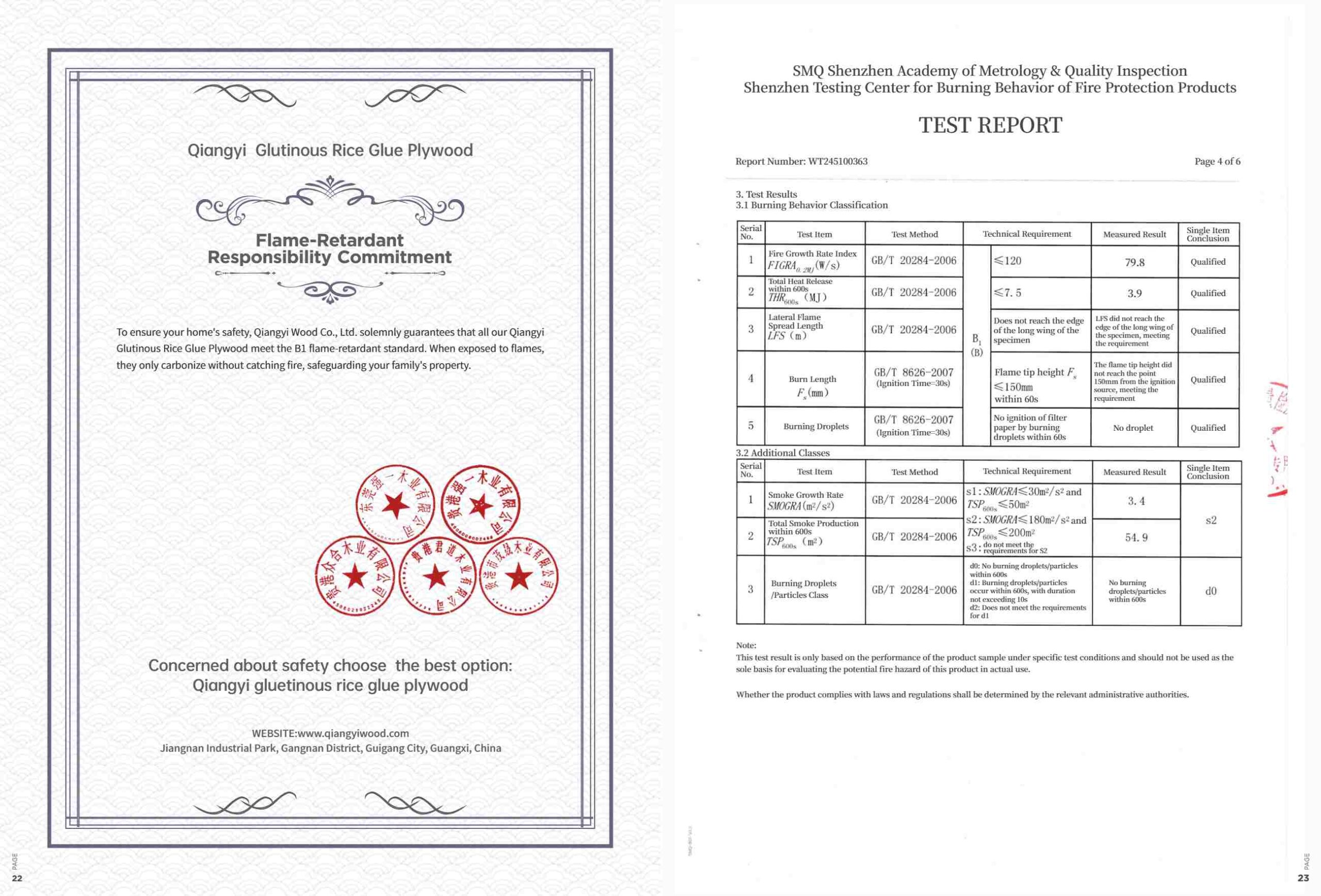
L'elevato costo delle violazioni delle norme antincendio nei progetti commerciali Ottenere l'approvazione per spazi commerciali come hotel, edifici pubblici e grandi negozi al dettaglio implica il rispetto di rigide normative di sicurezza. Tra le più importanti, figurano i codici antincendio degli edifici. Quando gli appaltatori di interni o gli acquirenti di progetti si riforniscono di materiali per mobili su misura, pannelli a parete o decorazioni d'interni, il pericolo nascosto spesso risiede nel nucleo dei pannelli di legno utilizzati. Il mancato superamento di un audit di conformità antincendio a causa di pannelli di legno non conformi è uno scenario che causa notevole ansia ai responsabili di progetto. Pertanto, comprendere le peculiarità del compensato ignifugo non è solo una necessità tecnica, ma una strategia fondamentale per la sopravvivenza aziendale. Perché il compensato standard o di bassa qualità cede in caso di incendio La vulnerabilità di molti pannelli da costruzione in caso di incendio deriva direttamente dalla loro composizione interna e dai processi di fabbricazione. I pannelli in legno standard o quelli ignifughi di scarsa qualità spesso presentano punti deboli strutturali nascosti che diventano fatali sotto l'effetto del calore estremo. Un problema principale è rappresentato dagli spazi vuoti o dalle fessure all'interno degli strati centrali dei pannelli standard. Il calore elevato raggiunge queste minuscole sacche d'aria, che a loro volta rilasciano ossigeno, accelerando la combustione. Il materiale, invece di contrastare il calore, alimenta le fiamme, consentendo al fuoco di propagarsi rapidamente all'interno della struttura. Inoltre, le colle utilizzate nei normali processi di produzione causano grossi problemi. Molti pannelli più vecchi utilizzano resine urea-formaldeide. Queste colle comuni non hanno la resistenza chimica necessaria per resistere alle alte temperature. Quando si sviluppa un incendio, queste colle si degradano rapidamente, compromettendo la resistenza strutturale del pannello, che di conseguenza si disintegra. Ancor peggio, la fusione di queste resine comuni produce fumi altamente tossici, che rappresentano un pericolo maggiore per le persone e i vigili del fuoco rispetto alle fiamme stesse. Criteri essenziali per un compensato ignifugo di classe B1 Gli acquirenti B2B desiderano ridurre al minimo questi rischi significativi e superare agevolmente gli audit di progetto. Per raggiungere questo obiettivo, devono stabilire regole rigorose nella scelta dei materiali per interni. Un pannello ignifugo di qualità è molto più di un semplice rivestimento superficiale: necessita di un nucleo appositamente progettato per condizioni estreme. La prima regola è una struttura interna liscia e ad alta densità. Il nucleo deve essere completamente solido. Questo elimina le sacche d'aria che alimentano il fuoco. Questa struttura spessa impedisce al calore e alle fiamme di penetrare rapidamente. In secondo luogo, il sistema di incollaggio deve essere naturalmente resistente al calore e sicuro. La colla che tiene insieme gli strati deve mantenere la sua tenuta anche a temperature molto elevate. Non deve decomporsi in gas pericolosi. Infine, il materiale deve superare test rigorosi e chiari per ottenere una classificazione di sicurezza riconosciuta, come la classificazione B1. La classificazione B1 indica che il materiale è difficilmente infiammabile, rallenta la propagazione del fuoco e si autoestingue quando la fonte di calore viene a mancare. Per i progetti commerciali, richiedere una documentazione scritta a supporto di queste caratteristiche è fondamentale per la gestione del rischio. Come il compensato QIANGYI riduce i rischi di incendio nelle costruzioni Per rispondere all'esigenza fondamentale di materiali di sicurezza affidabili, QIANGYI PLYWOOD ha sviluppato una soluzione che mira direttamente alle vulnerabilità strutturali dei materiali convenzionali. Reinventando il processo produttivo, questo pannello multistrato di seconda generazione offre una solida protezione contro i rischi di incendio, salvaguardando sia la proprietà che la continuità aziendale. Anima in eucalipto e struttura completamente interconnessa per garantire l'integrità strutturale. Il fondamento di questa capacità difensiva risiede nella selezione dei materiali e nella tecnica di assemblaggio. Questo compensato avanzato utilizza un'anima in eucalipto di prima qualità, una specie legnosa rinomata per la sua naturale elevata densità e resistenza. Per eliminare i vuoti interni, viene impiegato un processo di produzione con anima completamente connessa. Durante questo processo, ogni strato di impiallacciatura di eucalipto di alta qualità viene meticolosamente allineato e incollato. Ciò crea una struttura interna solida e priva di fessure. Se sottoposta a calore intenso, questa densità uniforme agisce come una barriera fisica, privando il materiale dell'ossigeno necessario per una rapida combustione. Di conseguenza, il pannello mantiene la sua integrità strutturale per lunghi periodi, prevenendo il crollo improvviso di rivestimenti murali o arredi su misura per hotel, rallentando così la propagazione complessiva di un incendio. Tecnologia ignifuga B1 e colla di riso glutinoso ecologica La barriera fisica del nucleo di eucalipto è amplificata da un rivoluzionario sistema di difesa chimica. Invece di affidarsi a resine sintetiche volatili, il processo di produzione utilizza una colla di riso glutinoso Lingmei brevettata. Questo adesivo innovativo è formulato con amido di riso glutinoso naturale combinato con cloruro di magnesio e ossido di magnesio. L'ossido di magnesio è un potente isolante termico naturale. Ha un punto di fusione molto elevato. Mescolandolo alla colla di riso glutinoso, conferisce all'intero pannello un'elevata resistenza al calore. Sottoposto a temperature estreme, il pannello subisce un processo di carbonizzazione graduale. Non brucia attivamente, ma si comporta in modo molto simile al carbone ardente.Inoltre, la colla non contiene formaldeide né benzene aggiunti. Per questo motivo, non emette fumi tossici quando è calda. Questa doppia azione di carbonizzazione fisica e assenza di fumi tossici garantisce il rispetto delle più severe normative in materia di sicurezza e ambiente. Ciò riduce notevolmente i rischi legali per gli appaltatori del progetto. Prove verificate: sicurezza comprovata per gli acquirenti B2B Per i responsabili degli acquisti e gli appaltatori di interni, le affermazioni di marketing devono essere supportate da prove concrete. Il vero valore di un prodotto per la sicurezza si dimostra attraverso le sue prestazioni in rigorosi test e la sua validazione da parte di autorevoli enti normativi. Test di esposizione diretta al fuoco: compensato di riso glutinoso contro compensato comune. Le prove visive offrono una dimostrazione convincente delle prestazioni dei materiali. Nei test comparativi di esposizione diretta al fuoco, le differenze di comportamento tra il compensato comune e il compensato di riso glutinoso sono evidenti. Se esposto a una fiamma libera continua, il compensato comune si incendia rapidamente, alimentando il fuoco e degradandosi velocemente in cenere. Al contrario, quando il pannello di riso glutinoso di seconda generazione viene esposto alla stessa fiamma diretta, mostra una notevole resistenza. La superficie si carbonizza lentamente, creando uno strato protettivo carbonizzato, ma si rifiuta di prendere fuoco o di alimentare una fiamma sostenuta. Una volta che il materiale infiammabile all'interno si esaurisce, qualsiasi minima combustione latente si autoestingue. Questa prestazione osservabile fornisce un'immediata conferma della capacità del materiale di contenere i rischi di incendio in scenari reali. Certificazione e conformità ufficiali per audit di progetto senza intoppi Per garantire audit edilizi senza intoppi, la conformità documentata è essenziale. Questo prodotto è supportato da test completi condotti dalla Shenzhen Academy of Metrology & Quality Inspection (SMQ), un ente di certificazione riconosciuto. Secondo il rapporto di prova ufficiale WT245100363, il prodotto soddisfa pienamente i rigorosi requisiti di classificazione B1 (B). I dati di questo rapporto forniscono garanzie concrete per gli acquirenti B2B. L'indice di velocità di propagazione dell'incendio (FIGRA) è stato misurato a un valore eccezionalmente basso di 79,8 W/s, ben al di sotto del rigoroso limite di ≤ 120 W/s. Inoltre, il rilascio totale di calore entro 600 secondi (THR) è stato registrato a soli 3,9 MJ, superando agevolmente il requisito di ≤ 7,5 MJ. Il rapporto conferma anche prestazioni eccellenti in ulteriori classi di sicurezza, ottenendo una classificazione s2 per la produzione di fumo e una classificazione d0, che indica l'assenza di goccioline o particelle in combustione durante il test. Questi parametri certificati convalidano legalmente l'impegno che il materiale si carbonizzi soltanto senza prendere fuoco, fornendo agli appaltatori la documentazione inconfutabile necessaria per superare i rigorosi controlli di sicurezza commerciali ed evitare completamente i costi catastrofici delle rilavorazioni. Incontra QIANGYI PLYWOOD alla Fiera Internazionale dei Prodotti Forestali e del Legno del Guangxi 2026 QIANGYI PLYWOOD è lieta di accogliere visitatori e offrirvi soluzioni affidabili per il compensato. In occasione della fiera, i visitatori potranno approfondire la conoscenza dei nostri prodotti in compensato, discutere le esigenze del progetto e comunicare direttamente con il nostro team in merito alla scelta dei materiali e a potenziali collaborazioni. Nome dell'evento: LA MOSTRA INTERNAZIONALE DEI PRODOTTI FORESTALI E DEL LEGNO DEL GUANGXI 2026 Numero dello stand: D5T-06 Luogo: Centro Congressi e Fieristico Internazionale di Nanning Data: 21-23 novembre 2026 FAQ D: Cosa significa compensato ignifugo B1 per i progetti commerciali? A: Nel contesto dell'edilizia commerciale, la classificazione B1 indica un materiale difficilmente infiammabile e classificato come non infiammabile in condizioni standard. Per hotel, centri commerciali ed edifici pubblici, l'utilizzo di materiali certificati B1 non è facoltativo, ma un requisito obbligatorio per conformarsi alle normative edilizie locali. L'impiego di materiali conformi a questo standard è il metodo principale che gli appaltatori adottano per superare i controlli di sicurezza, riducendo così le responsabilità legali ed evitando ritardi nei progetti. D: In che modo il compensato ignifugo riduce i rischi di dover rifare il progetto? A: Acquistare pannelli in legno ignifugo con certificazione effettiva fin dall'inizio di un progetto è una decisione strategica di gestione del rischio. Garantisce che le installazioni interne superino i controlli di sicurezza obbligatori al primo tentativo. Il mancato superamento di tali controlli a causa di materiali non conformi si traduce nella disastrosa situazione di dover demolire il lavoro già completato, acquistare nuovi materiali e sostenere i costi di una seconda installazione. L'investimento iniziale in materiali conformi elimina completamente queste ingenti spese di rilavorazione. D: Perché un nucleo di eucalipto completamente connesso è importante per la resistenza al fuoco? A: La struttura fisica del pannello è fondamentale per le sue prestazioni in presenza di calore. Un processo di connessione completa del nucleo elimina le fessure e i vuoti microscopici che esistono naturalmente tra gli strati di materiali meno raffinati. Eliminando queste fessure, si interrompono i percorsi che l'ossigeno potrebbe utilizzare per alimentare un incendio. Inoltre, l'eucalipto è un legno naturalmente ad alta densità. D: Può il ritardante di fiamma B1Il compensato può essere utilizzato per mobili su misura per hotel? R: Sì, è un materiale ideale per tali applicazioni. Armadi per hotel, mobili su misura e rivestimenti decorativi per pareti devono rispettare rigorosi standard di sicurezza pubblica. Questo specifico materiale di seconda generazione non solo soddisfa gli esigenti requisiti di resistenza al fuoco B1, ma utilizza anche un adesivo a base di riso glutinoso unico nel suo genere. Ciò garantisce che i mobili su misura rimangano completamente privi di emissioni di formaldeide, soddisfacendo contemporaneamente sia le severe normative di sicurezza che gli elevati standard di qualità dell'aria interna. D: Come scegliere il compensato migliore per ridurre il rischio di incendio negli edifici pubblici? A: Nella selezione dei materiali per minimizzare i rischi, gli acquirenti commerciali dovrebbero stabilire criteri di approvvigionamento rigorosi. In primo luogo, richiedere documentazione ufficiale verificata, come i rapporti di prova SMQ, che attestino una classificazione B1 e punteggi FIGRA eccellenti. In secondo luogo, informarsi sulla composizione interna; dare priorità ai materiali caratterizzati da specie ad alta densità come l'eucalipto e da una struttura interna senza giunture e completamente connessa.
Consigli per l'acquisto di compensato resistente all'umidità per i mobili del bagno.
The Hidden Cost of Bathroom Vanity Delamination When manufacturing cabinets for wet environments, the commercial stakes are incredibly high. Bathrooms experience constant humidity, steam from daily showers, and frequent water splashes around the washbasin. If you supply vanities made from inadequate materials, moisture will inevitably penetrate the exposed edges. This intrusion leads directly to edge swelling, adhesive failure, and severe veneer delamination. For cabinet manufacturers and interior contractors, these material failures are not just minor inconveniences. They translate into expensive after-sales claims, free part replacements, and wasted manual labor hours. Furthermore, delivering failing products destroys your brand reputation, leading to negative reviews and drastically reduced profit margins. Finding a truly reliable waterproof material for kitchen cabinets and bathroom furniture is essential to eliminating these hidden financial drains, protecting your business, and keeping your end-user clients fully satisfied over the long term. Why Standard Plywood Fails in High-Humidity Bathrooms Many normal waterproof plywood choices sold today just cannot handle steady bathroom dampness. The main reason usually comes down to two basic things. These are the wood type and the adhesive structure. Most regular boards use softwood cores or medium-density fiberboard. Softwood has a low physical density. It also has wide, open cell pores. These pores pull in water drops from the damp air. After the water gets inside, the inner wood fibers swell fast. Also, normal moisture-resistant boards use standard urea-formaldehyde resin glue. This common chemical glue is not stable when it faces steady wetness and heat changes. It goes through bad chemical reactions. It breaks down over time and loses its main grip strength. This breakdown surely makes the surface layers peel off from the center. To fix this endless loop of failure, we must look past normal making methods. We must avoid weak material pairings. Key Criteria: How to Choose Plywood for Bathroom Furniture Selecting the best plywood for high humidity areas requires moving past basic marketing claims and focusing strictly on material science. A truly good board must have a high-density core. This core physically stops fast water entry before it begins. Also, it requires a highly stable, water-resistant adhesive that will not chemically break down under extreme moisture stress. You must also think about the full cost of ownership. Do not just look at the first buying price. High-quality anti-swelling plywood for cabinets might cost a bit more at the start. However, it strongly guards your long-term profits. It does this by wiping out warranty claims and repair visits. It also stops bad buyer feedback. How QIANGYI PLYWOOD Solves Vanity Swelling To completely resolve the commercial pain points of edge swelling and delamination, we completely reengineered our board structure from the inside out. We eliminated the conventional materials that cause typical industry failures and developed a targeted solution specifically tailored for high-humidity applications, that is glutinous rice glue plywood. Our approach combines a premium hardwood substrate with an innovative natural adhesive to deliver unmatched stability. 100% Eucalyptus Core for Superior Density The base of our moisture-resistant board is a full eucalyptus core. Eucalyptus is a fine hardwood. It acts very differently from the softwood that other brands use. Eucalyptus has a much higher physical density. Because of this, its inner cell layout has much fewer open spaces. This thick hardwood makeup builds a strong physical wall. This wall greatly slows down water entry. We use a 100% eucalyptus plywood build with Grade 1 core layers. Because of this, the glutinous rice glue plywood stops the fast water intake that usually ruins bathroom vanities. This keeps the shape very stable, even in the wettest rooms. It protects the physical strength of your finished cabinets. Glutinous Rice Glue for Waterproof Bonding To complement our dense hardwood core, we utilize an advanced glutinous rice glue. This specialized, formaldehyde-free adhesive is formulated from glutinous rice starch, magnesium chloride, water, and magnesium oxide. Unlike traditional adhesives that weaken when wet, our glutinous rice glue features strong penetration capabilities. We apply this glue layer by layer, allowing it to completely fill the microscopic gaps between the eucalyptus wood fibers. Once cured, it forms a dense, water-resistant crystalline network that physically blocks water molecules from touching the wood fibers. Compared to traditional urea-formaldehyde resin adhesives, the glutinous rice glue structure exhibits higher stability in humid environments, significantly reducing the risk of ungluing and delamination caused by moisture. Proven Evidence: Will It Survive the Bathroom Environment? B2B buyers need more than just promises; they need verifiable data to mitigate procurement risks. Class II Waterproof Certification & Boiling Test QIANGYI PLYWOOD’s manufacturing standards are validated by rigorous third-party evaluations. As detailed in our Test report, our glutinous rice glue plywood has officially achieved Class II waterproofing certification. This strict classification means the board is specially designed to endure damp conditions and short-term hot water immersion. During the mandatory immersion peeling tests, our samples were submerged in 63 degrees Celsius hot water. The test results demonstrated a flawless 100% pass rate with zero delamination. This official testing guarantees that our boards possess the structural integrity necessary to survive the harsh realities of a bathroom environment without compromising your finished product. 72-Hour Immersion Test vs. Ordinary Plywood Real-world testing visually demonstrates our board’s superiority. In a recent video test demonstrating our plywood’s true waterproof capabilities, we conducted a direct immersion comparison. We submerged our glutinous rice board alongside ordinary boards in water for an extended 72-hour period. The results were undeniable. While the standard materials exhibited significant, visible swelling, our board remained remarkably stable. The thickness of our plywood only changed microscopically, moving from 18.20mm to 18.39mm after 72 hours underwater. In stark contrast, the ordinary plywood swelled significantly from 18.13mm to 19.05mm, and the MDF board expanded even more drastically from 18.30mm to 20.66mm. The test results demonstrate that under the same immersion conditions, the thickness variation of our eucalyptus core glutinous rice glue plywood is significantly lower than that of ordinary plywood and MDF. For bathroom vanity manufacturers, this lower expansion risk helps reduce cabinet deformation, edge cracking, veneer delamination, and after-sales claims, thereby improving project delivery stability and long-term profit margins. Real-World Case Study: Success in the Humid Philippines A leading furniture materials distributor in the Philippines faced challenges with the country’s hot, humid climate. Seeking a durable solution, they partnered with us after discovering our Glutinous Rice Glue plywood. The results were exceptional. The plywood’s natural adhesive, ENF grade, and superior waterproof and termite-proof capabilities perfectly addressed local market needs. These features significantly reduced their clients’ maintenance and rework costs caused by moisture swelling and severe termite damage. Starting with a conservative single-color trial order, the overwhelming positive market response led the distributor to quickly expand their range. Today, they feature a fully customized color palette and successfully promote our glutinous rice plywood as their flagship premium series. Experience Our Waterproof Technology in Person If you are looking to completely resolve the commercial pain points of edge swelling and delamination, we invite you to inspect our premium moisture-resistant plywood firsthand. Come meet our experts and see the physical proof of our material stability. *Event Name:THE 2026 GUANGXI INTERNATIONAL FOREST PRODUCTS AND WOOD PRODUCTS EXHIBITION *Booth Number:D5T-06 *Location/Address:Nanning International Convention & Exhibition Center *Date:November 21-23, 2026 FAQ Q: What is the best waterproof plywood for bathroom cabinets? A: While no wood product is entirely impervious to water forever, the most reliable commercial solution is a combination of a dense hardwood core and a highly water-resistant adhesive. A full eucalyptus core combined with glutinous rice glue currently offers the absolute best defense against edge swelling and delamination in humid bathroom conditions, making it ideal for professional vanity manufacturing. Q: Does full eucalyptus core plywood prevent edge swelling? A: Yes, it significantly reduces the risk. Eucalyptus is a dense hardwood, which means its internal cellular structure is much tighter than that of typical softwood. This high density naturally minimizes the empty pores where water can accumulate, physically restricting moisture penetration and preventing the vanity edges from expanding when exposed to bathroom humidity. Q: Why should cabinet manufacturers choose glutinous rice plywood over standard moisture-resistant boards? A: Standard boards rely on conventional chemical adhesives that gradually degrade when exposed to continuous moisture. Our glutinous rice glue creates a stable crystalline structure that locks out water molecules and maintains its strong bond even after severe water exposure. This directly translates to fewer customer complaints, zero rework, and a heavily protected brand reputation. Q: How can I verify the waterproof performance of plywood before buying? A: You should always request official laboratory testing data from your supplier. Look for documents like our test report, which confirms a 100% pass rate in Class II hot water immersion peeling tests. Additionally, seek out visual proof, such as our 72-hour water submersion videos, to directly compare material expansion rates before committing to a purchase. Q: Will using moisture-resistant plywood increase my manufacturing costs? A: You must evaluate this through the precise lens of total cost of ownership. While a premium full eucalyptus board might have a marginally different upfront purchase price, it completely eliminates the hidden costs of vanity failures. By preventing expensive after-sales repairs, free replacement parts, and lost future business due to bad reviews, it ultimately increases your overall profitability and business growth.
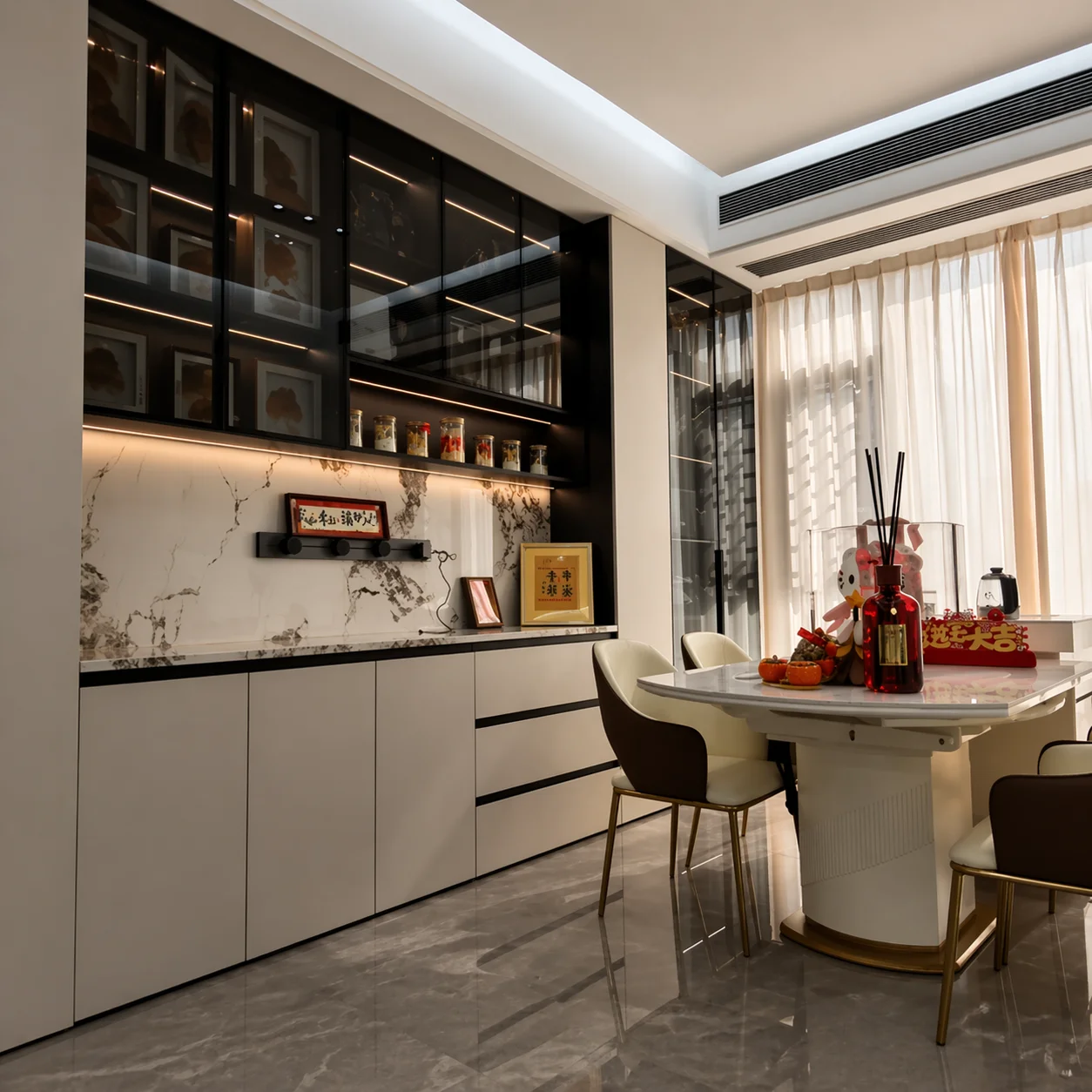
Guida al compensato indeformabile per interni umidi
Un'anta di un armadio può uscire piatta in officina e deformarsi mesi dopo. In appartamenti umidi, hotel sulla costa, cucine, bagni e armadi adiacenti a pareti umide, il compensato è soggetto a ripetuti sbalzi di umidità. Per gli installatori di interni, questo può significare rilavorazioni, ritardi nella consegna e richieste di garanzia. La questione chiave è come specificare un compensato resistente alla deformazione. Perché la deformazione del compensato diventa un problema costoso negli allestimenti interni in ambienti umidi Dove si manifestano le deformazioni dovute all'umidità dopo l'installazione La deformazione è frequente quando i pannelli sono larghi, usati di frequente o esposti in modo non uniforme. Le ante dei mobili da cucina possono incurvarsi, i mobili del bagno possono incurvarsi in prossimità di pareti umide, le ante degli armadi alti possono presentare fessure irregolari e gli arredi degli hotel in prossimità di pareti esterne possono essere soggetti a ripetuti cicli di umidità. I primi segnali sono lievi: un bordo non aderisce più perfettamente, il frontale di un cassetto si deforma o la bordatura si solleva. Una volta che i componenti vengono compromessi, un difetto estetico si trasforma in un problema funzionale. Da un pannello deformato a rilavorazioni, ritardi e interventi in garanzia La sostituzione di un pannello potrebbe richiedere un'ulteriore visita in loco, lavori di rifinitura, la regolazione delle cerniere e il coordinamento con il cliente. Nei progetti che coinvolgono più stanze, i costi si moltiplicano. Il movimento dei pannelli causa un allineamento errato; un allineamento errato richiede interventi correttivi; gli interventi correttivi consumano manodopera, materiali e tempo. La stabilità dimensionale deve pertanto essere inclusa nelle specifiche di acquisto. Perché il compensato si deforma, si incurva o si delamina in ambienti umidi? Le variazioni di umidità creano gonfiore e restringimento irregolari Il compensato è laminato a strati incrociati, il che contribuisce a limitare i movimenti del legno, ma i suoi strati di impiallacciatura assorbono e rilasciano comunque umidità al variare dell'umidità ambientale. I problemi iniziano quando questi movimenti sono irregolari. Un'anta di un mobile accanto a un lavandino può assorbire più umidità sui bordi che sulla superficie decorativa. Un armadio appoggiato a una parete fredda può essere soggetto a condizioni diverse sul retro e sul davanti. Le sollecitazioni risultanti possono manifestarsi come incurvamenti, deformazioni, torsioni o cedimenti localizzati dell'incollaggio. La costruzione sbilanciata del nucleo e le tensioni residue amplificano il problema. L'umidità è spesso il fattore scatenante, ma non l'unica causa. Spazi vuoti all'interno del pannello, umidità non uniforme dell'impiallacciatura, scarsa simmetria o tensioni residue possono rendere un pannello più sensibile. Una stratificazione bilanciata distribuisce le forze su tutta la lastra. Un nucleo irregolare può reagire in modo non uniforme, rendendo più evidenti le instabilità nascoste dopo il taglio. Perché pannelli più spessi, laminati di superficie o semplici fissaggi hardware non sono sufficienti Lo spessore aumenta la rigidità, ma non corregge l'instabilità del nucleo. Un laminato superficiale può rallentare la penetrazione dell'umidità, ma i bordi tagliati, i fori e i lati posteriori non sigillati rimangono esposti. Un maggior numero di cerniere può controllare meccanicamente il movimento, ma non può riparare incollaggi deboli. Queste soluzioni sono più efficaci quando il pannello di base è già adatto all'ambiente. Quali caratteristiche deve dimostrare il compensato resistente alla deformazione prima di essere scelto come materiale di consumo? Cerca una struttura del nucleo bilanciata e un movimento dell'umidità controllato. Prima di specificare il compensato per un ambiente interno umido, verificate tre aspetti fondamentali: 1. Consistenza del nucleo: impiallacciature ben accoppiate e strati bilanciati riducono i punti deboli locali. Per quanto riguarda la selezione del materiale del nucleo, l'utilizzo di legni duri come l'eucalipto di grande diametro può migliorare significativamente la resistenza alla deformazione del pannello grazie a vantaggi quali l'assenza di nodi, l'elevata resistenza e il mantenimento di una qualità stabile. 2. Controllo dell'umidità: l'umidità interna deve essere controllata prima che il pannello lasci la produzione. 3. Strategia per bordi e superfici: la finitura, la foratura, la sigillatura e l'installazione devono limitare l'esposizione irregolare dopo il taglio. Un pannello idoneo non è semplicemente "impermeabile". La struttura interna, l'incollaggio, il condizionamento e l'installazione devono lavorare in sinergia. Dati sull'integrità e la rigidità delle obbligazioni e prove di test corrispondenti all'applicazione. Gli acquirenti dovrebbero chiedere cosa è stato testato, quale requisito è stato applicato e se la costruzione testata corrisponde al pannello preventivato. Cosa verificare Perché è importante Peeling per immersione Verifica l'integrità della linea di incollaggio dopo l'esposizione all'umidità. resistenza alla flessione Indica resistenza alla rottura per flessione Modulo di elasticità Aiuta a valutare la rigidità e la deflessione Nucleo, spessore e superficie Conferma che le prove corrispondono all'ordine Questo è importante per le ante degli armadi, gli scaffali lunghi e i mobili da bagno, dove anche il minimo movimento diventa subito visibile. Come QIANGYI PLYWOOD contrasta la deformazione causata dall'umidità Noi di QIANGYI PLYWOOD affrontiamo il problema della deformazione controllando il pannello dal nucleo verso l'esterno, anziché affidarci esclusivamente a una descrizione superficiale. La struttura multistrato bilanciata e il condizionamento controllato riducono le tensioni interne. Il nostro compensato di riso glutinoso utilizza una stratificazione a nucleo pieno con incollaggio strato per strato. La produzione prevede oltre 24 ore di pressatura a freddo lenta, circa 60 ore di asciugatura e oltre 15 giorni di stagionatura e condizionamento. Il ciclo più lungo ha lo scopo di migliorare l'adesione, uniformare l'umidità interna e consentire alle tensioni residue di stabilizzarsi prima della lavorazione. Spesso, dopo il taglio e l'installazione, si verificano deformazioni. Un'umidità più uniforme e una struttura equilibrata contribuiscono a ridurre la concentrazione di stress all'interno del pannello. ADH penetrante del riso glutinosoEsigente aiuta a limitare il gonfiore causato dall'umidità Il sistema adesivo utilizza amido di riso glutinoso con cloruro di magnesio, ossido di magnesio e acqua. Dopo la polimerizzazione, è progettato per penetrare nella struttura del legno e formare una rete di legame densa. Il pannello in amido di riso glutinoso ha un contenuto di umidità controllato tra l'8% e il 12%, mentre la sua classificazione di resistenza all'acqua di Classe II è pensata per ambienti umidi piuttosto che per l'immersione prolungata. Nelle cucine, negli armadi e nei mobili da bagno, l'obiettivo è limitare il rapido assorbimento di umidità e il conseguente rigonfiamento. Le proprietà antimuffa e antibatteriche offrono una protezione secondaria negli ambienti umidi. L'umidità può creare problemi biologici anche prima che si verifichino deformazioni visibili. Tutti i pannelli di compensato con colla di riso glutinoso di QIANGYI PLYWOOD sono realizzati in eucalipto di grande diametro, che possiede naturali proprietà antibatteriche. Nel nostro sistema di pannelli con colla di riso glutinoso, la resistenza alla muffa è di Grado 0 e il tasso antibatterico è superiore al 99%. Il processo combina il sistema adesivo con un'asciugatura controllata di 60 ore e un controllo dell'umidità nell'intervallo 8-12%. Queste proprietà favoriscono la stabilità dimensionale, ma non la sostituiscono. Sono utili in cucine, mobili da bagno, guardaroba e interni in zone costiere dove possono persistere condizioni di caldo e umidità. Prove derivanti dai test, il caso Mauritius e il valore della stabilità dimensionale negli appalti. Il rapporto di prova SZF-WT-25082006-02 fornisce prove dell'integrità dell'adesione e delle prestazioni strutturali. La pagina del rapporto mostra sei campioni validi per ogni elemento e un tasso di superamento del 100%. Elemento di prova Requisito mostrato Risultato Peeling per immersione Criteri di pelatura specificati 6/6 qualificati resistenza alla flessione, parallelo ≥22,0 MPa 6/6 qualificati Resistenza alla flessione, trasversale ≥20,0 MPa 6/6 qualificati Modulo elastico, parallelo ≥5000 MPa 6/6 qualificati Modulo elastico, trasversale ≥4000 MPa 6/6 qualificati Caso di studio: perché una fabbrica di mobili di Mauritius continuava a riordinare Un cliente di lunga data, un'azienda produttrice di mobili con sede a Mauritius, stava ricevendo il suo terzo rifornimento di container completo dell'anno. Il prodotto era compensato di qualità per mobili con anima in eucalipto al 100%. Mauritius ha un clima insulare caldo e umido, dove i pannelli comuni possono subire scrostature, deformazioni e danni da termiti nel tempo. Per questo cliente, abbiamo fornito compensato con anima in eucalipto, adesivo a base di riso glutinoso e un processo a temperatura controllata per migliorarne la stabilità in condizioni di umidità. Il prodotto è stato inoltre certificato con un punteggio di 9,5 nei test di resistenza alle termiti. Il cliente ha commentato che l'utilizzo del nostro compensato per i mobili ha contribuito a ridurre le preoccupazioni relative a problemi post-vendita. Anche la coerenza ha motivato gli acquisti ripetuti. La stabilità della tenuta dei chiodi e i bordi di taglio netti hanno permesso alla fabbrica di evitare frequenti aggiustamenti della produzione e di ridurre le perdite di materiale tra i lotti. Un altro aspetto da considerare era la consegna a lunga distanza. Per il trasporto marittimo, abbiamo rinforzato i bordi dei pallet e utilizzato più strati di imballaggio resistente all'umidità. Il cliente ha riferito che i pallet sono arrivati integri e che il compensato è rimasto asciutto dopo lo spacchettamento. In qualità di produttori diretti, siamo in grado di rispondere rapidamente a esigenze specifiche come dimensioni particolari o requisiti ambientali, aiutando i clienti abituali a mantenere una programmazione delle forniture più prevedibile. Per appaltatori e produttori di mobili, questo caso dimostra che la scelta del compensato non riguarda solo la resistenza alla deformazione. Anche la consistenza del lotto, la protezione durante il trasporto e l'affidabilità della fornitura influiscono sulle perdite di produzione, sui rischi post-vendita e sulla consegna del progetto. Scoprite di persona il nostro compensato indeformabile. Siete curiosi di constatare di persona la stabilità dimensionale e la qualità del nostro compensato? Vi invitiamo a contattare il nostro team per scoprire come i nostri prodotti possono garantire la sicurezza del vostro prossimo progetto di allestimento di interni umidi. *Nome dell'evento: LA MOSTRA INTERNAZIONALE DEI PRODOTTI FORESTALI E DEL LEGNO DEL GUANGXI 2026 *Nome dell'azienda: QIANGYI PLYWOOD *Numero dello stand: D5T-06 *Data: 21-23 novembre 2026 *Luogo/Indirizzo: Centro Congressi ed Esposizioni Internazionale di Nanning FAQ D: Quali sono le cause della deformazione del compensato in ambienti interni umidi? A: Il meccanismo principale è la distribuzione non uniforme dell'umidità. Diverse superfici, bordi o aree centrali assorbono e rilasciano umidità a velocità differenti. Lo squilibrio del nucleo, le tensioni residue, le linee di incollaggio deboli e la scarsa protezione dei bordi possono peggiorare il fenomeno. D: Cosa dovrebbero verificare gli appaltatori quando acquistano compensato resistente alla deformazione? A: È sempre necessario verificare la qualità del nucleo e ricercare una struttura equilibrata. Inoltre, è importante controllare il controllo dell'umidità, la forza di adesione, la resistenza alla flessione e la rigidità. Infine, assicurarsi che la documentazione di prova fornita corrisponda effettivamente allo spessore e alla struttura effettivi dell'ordine. D: Quali risultati dei test sono rilevanti nella valutazione del compensato resistente alla deformazione? A: Il test di pelatura per immersione aiuta a valutare l'integrità della linea di incollaggio dopo l'esposizione all'umidità. La resistenza alla flessione indica la resistenza alla rottura per flessione, mentre il modulo di elasticità è correlato alla rigidità e alla deflessione. I risultati sono più utili quando il campione testato corrisponde al prodotto specificato. D: La resistenza alla deformazioneIl compensato NT necessita ancora di sigillatura dei bordi e di una corretta installazione? R: Sì. Bordi tagliati, fori praticati, finiture irregolari, substrati umidi, stoccaggio inadeguato e disposizione errata della ferramenta possono comunque causare infiltrazioni di umidità o sollecitazioni localizzate. Un pannello stabile riduce il rischio, ma la fabbricazione e l'installazione rimangono parte della soluzione.
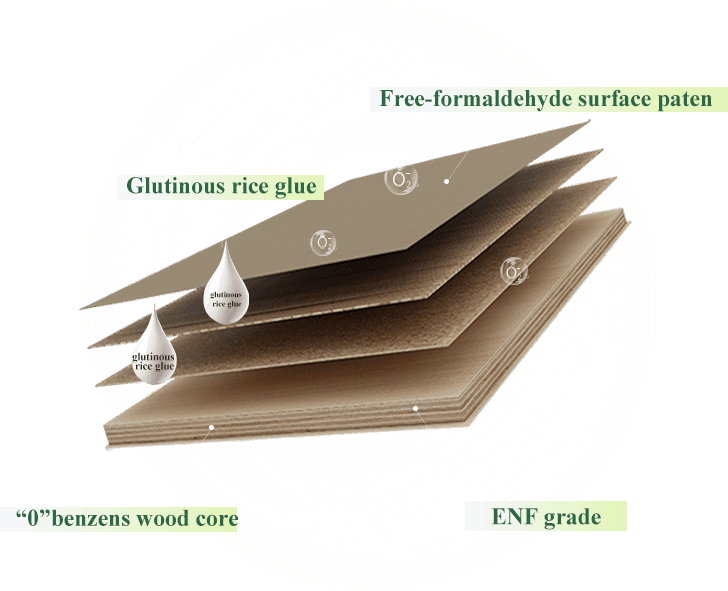
CERTIFICAZIONE
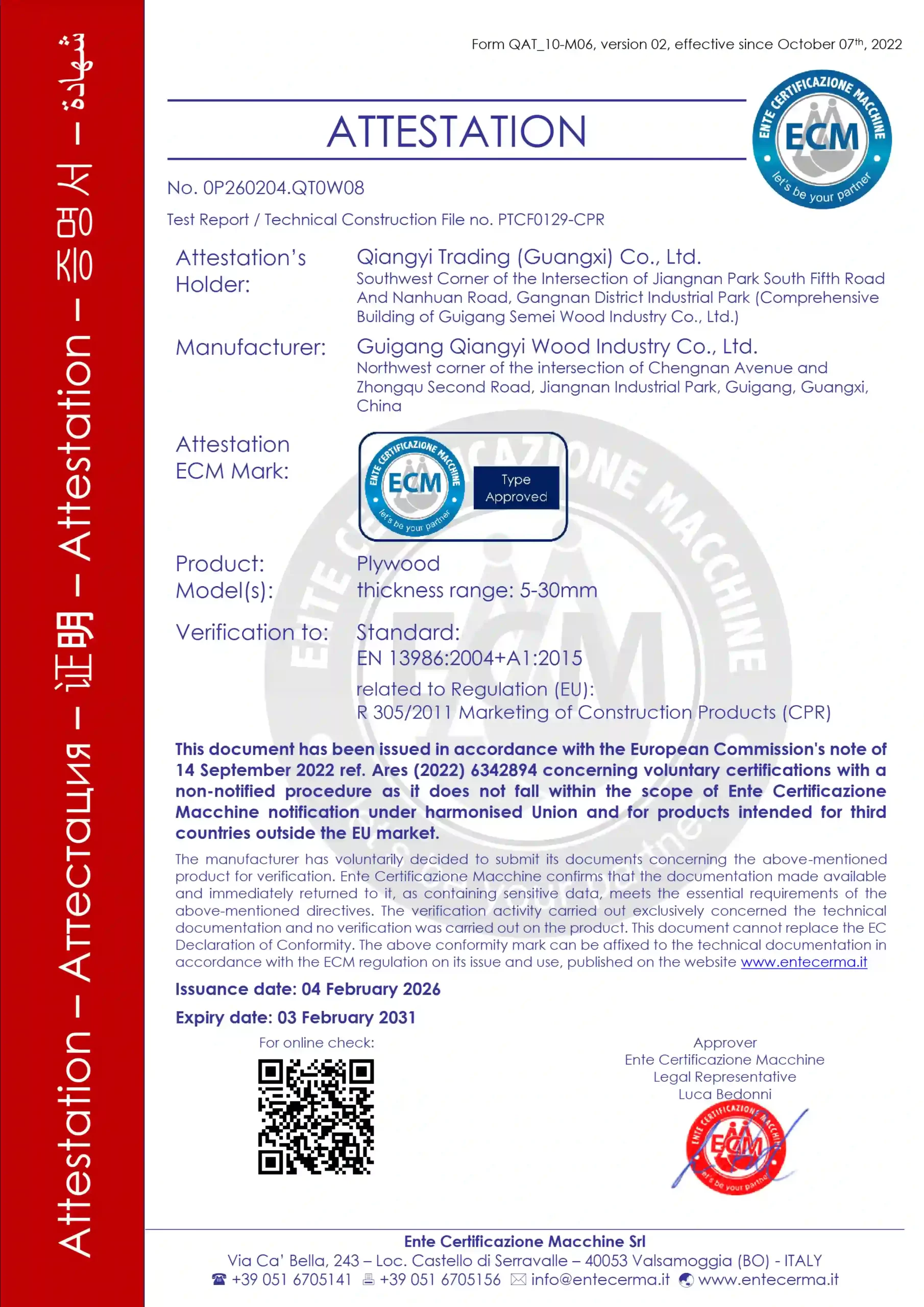
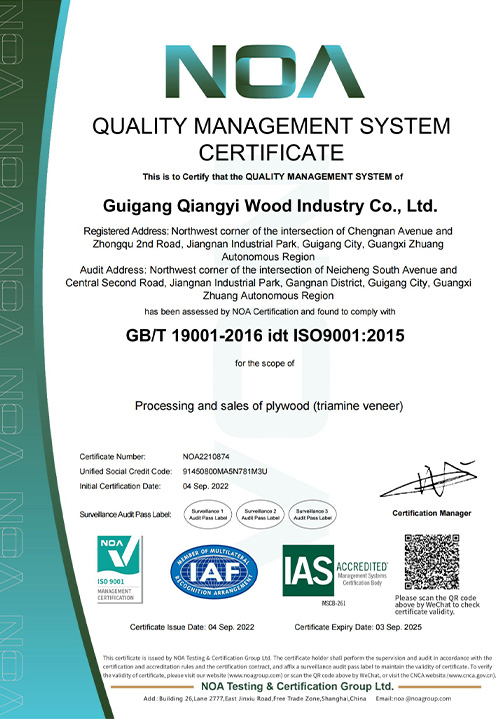
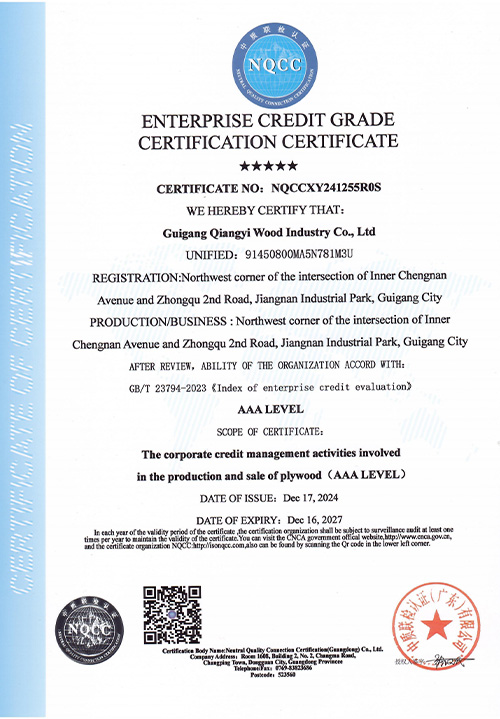
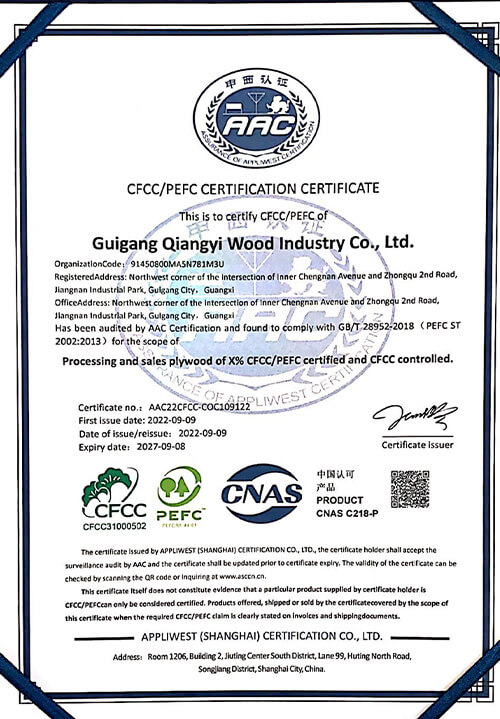
Please fill out the form below and we will get back to you as soon as possible.