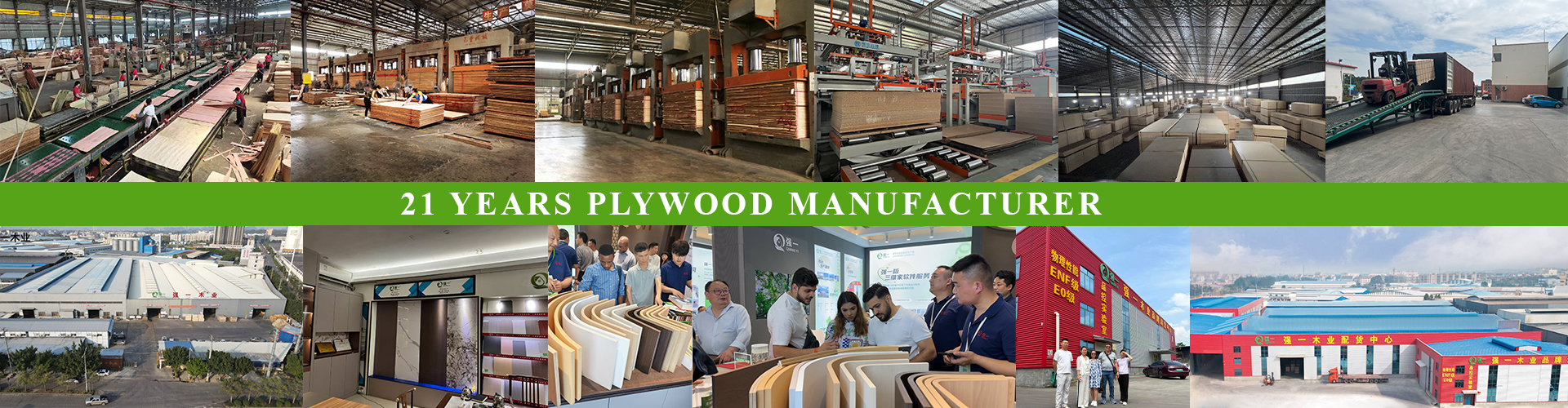
Yes ,We are manufacturer which locate in Guigang, Guangxi, also in Dongguang, Guangdong. Factory is started in the year of 2004 with more than 20 years experience for plywood production.

 Qiangyi
Choosing the right cabinet panel for your kitchen or bathroom goes beyond just cost. The wrong panel can lead to a host of problems, including loose hinges, sagging shelves, swollen edges, and ultimately the cost of replacement. We take into account the amount of load the panel will bear, the type of hardware that will be used, the level of moisture that the panel will be exposed to, and the expected service life of the panel to pick the best material for your needs.
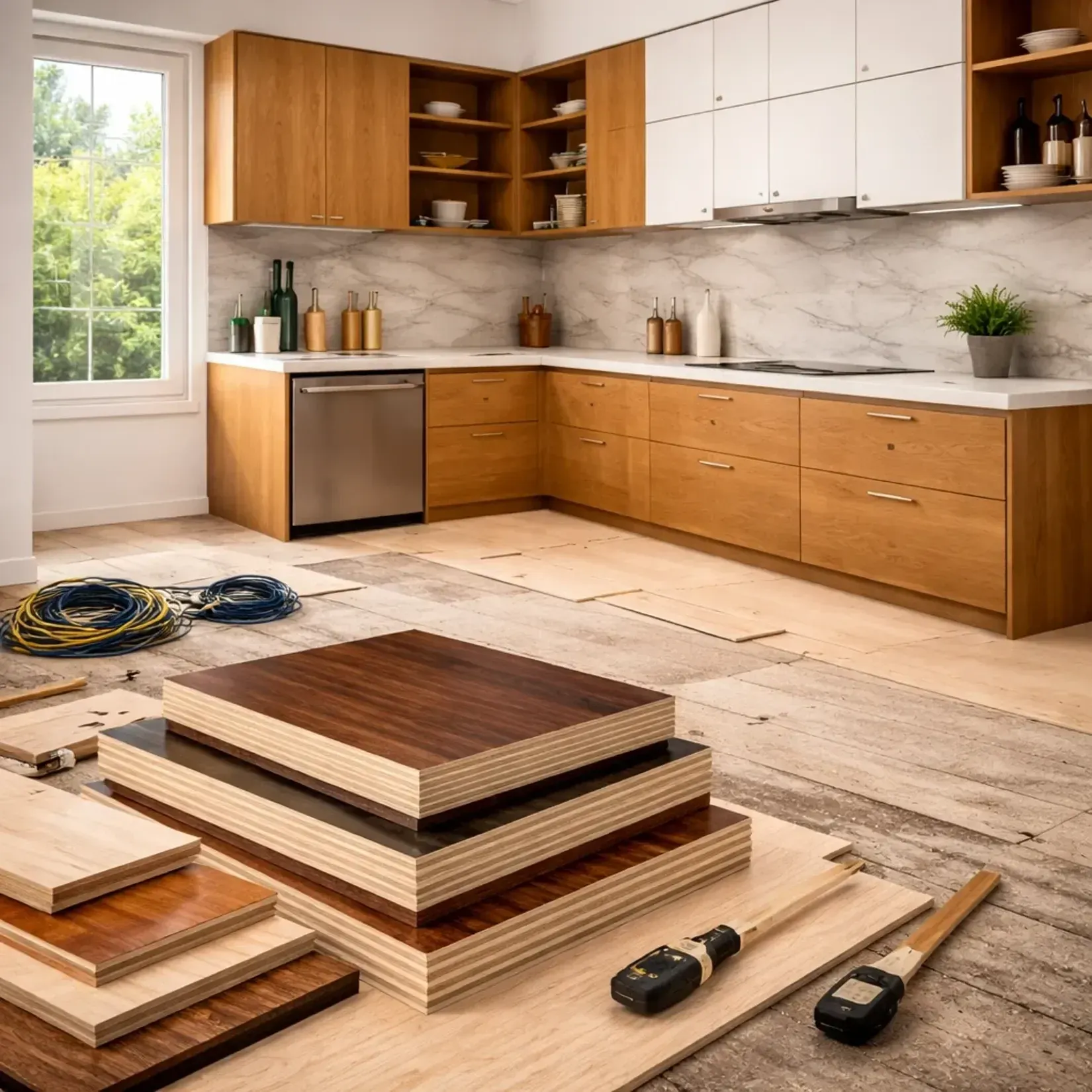
Plywood is more suited for use in cabinet boxes, long runs of shelving, large wall units and areas around the sink because it offers greater stability and durability in terms of loads, screw holding power and resistance to moisture damage. It provides a uniform surface at a lower initial cost than most other surfaces and is best suited for dry, low load bearing components.
| Decision Factor | Plywood | Particle Board |
| Strength | Better for demanding loads | Suitable for moderate loads with proper support |
| Screw Holding | Generally stronger | Depends more on panel density and fastener selection |
| Moisture Resistance | Usually more tolerant of moisture | Cut edges and openings require careful sealing |
| Surface Q
uality |
Depends on veneer and finishing quality | Provides a uniform surface for decorative finishes |
| Initial Cost | Normally higher | Normally lower |
| Best Use | Long-life and higher-risk cabinet installations | Budget-controlled projects in dry indoor environments |
The material name alone is not enough. Poor plywood can underperform, while well-made particle board with sealed edges can work reliably in the right setting.
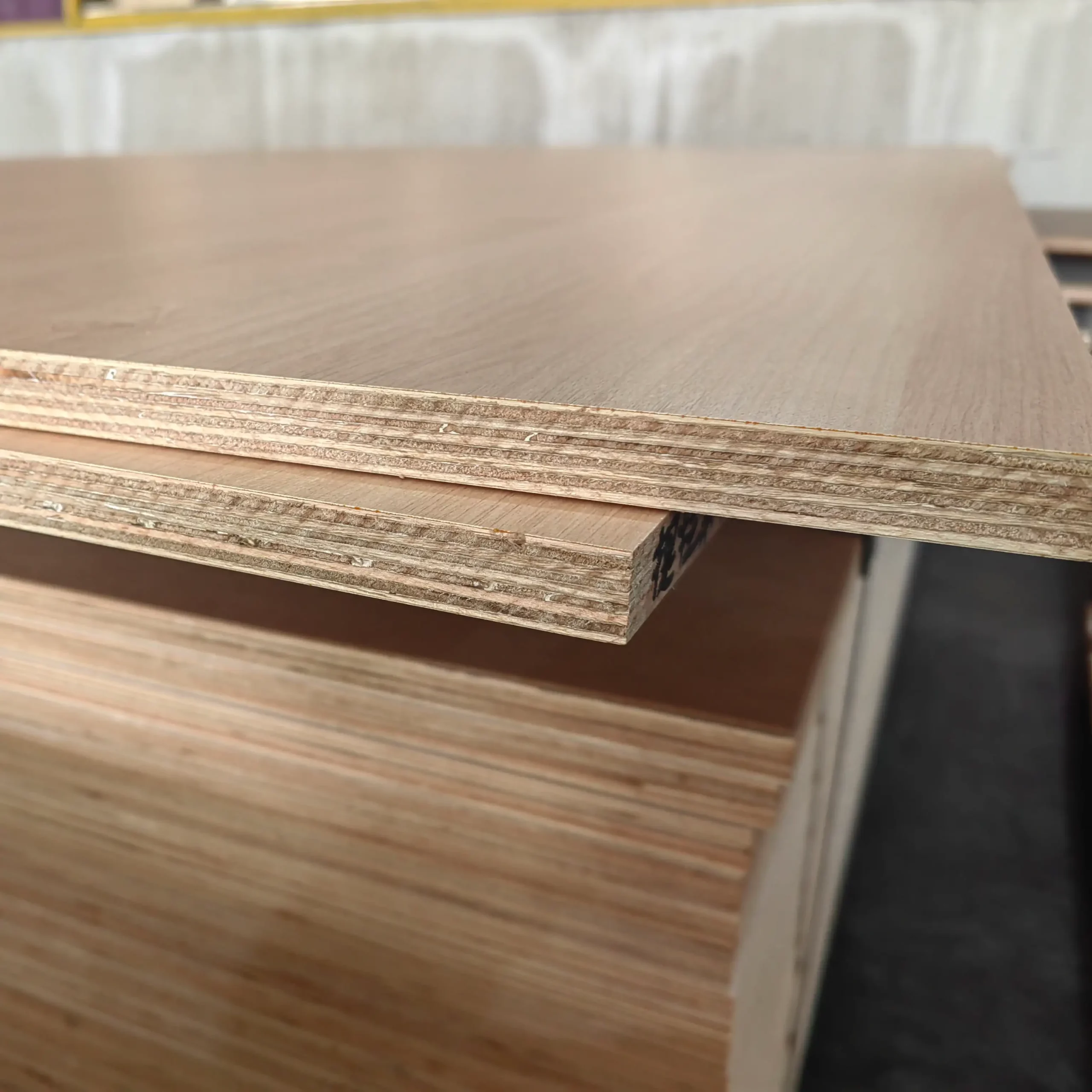
Plywood consists of multiple wood veneers bonded and pressed together under high temperature and pressure, with adjacent grain directions arranged across one another. This construction distributes internal stress within the panel and helps resist splitting. Core species, veneer grade, ply count, glue performance, moisture content, and internal gaps all affect the finished board.
Buyers should inspect both faces and edges because screw fasteners pass through multiple veneer layers, making edge integrity directly relevant to installation stability.
Particle board is made from wood scraps and particles mixed evenly with an eco-friendly adhesive and hot-pressed under high temperature and pressure into an integrated panel. Its uniform, flat structure makes it a high-quality substrate for melamine, PET, and other decorative finishes.
A cabinet side mainly carries vertical loads, while a wide shelf is especially prone to bending and sagging when the span is long or the stored load is heavy. Plywood is generally better suited to long shelves, stone-supported base cabinets, and commercial storage because its cross-laminated structure distributes stress.
Particle board can perform well when spans are shorter or reinforced. Specify panel thickness, shelf width, expected load, rear support, and edge treatment together rather than choosing a cabinet board material by price alone.
Repeated door use creates continuous pulling forces at hinges and screw-fixing points. Plywood normally provides stronger screw holding because fasteners engage continuous veneers.
Particle board performance depends on density, pilot-hole accuracy, screw type, depth, and edge distance. For heavy doors, use tested connectors and avoid repeated screw removal and reinstallation to prevent the fixing holes from loosening or failing.
Water commonly enters through an unsealed edge, sink cutout, plumbing opening, or damaged banding. Particle board can swell when moisture reaches its internal particles, and the damage may be irreversible.
Plywood is usually more moisture tolerant, but it is not automatically waterproof. Glue grade, core quality, surface treatment, and edge sealing still matter. Around sinks or vanities, seal every cut edge and opening, not only the visible front.
Particle board suits decorative surfaces and automated production. Plywood may provide better edge integrity and fastening strength, although machining quality varies.
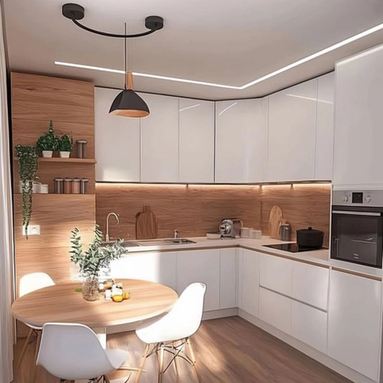
QIANGYI PLYWOOD offers melamine and PET-faced options in matte, glossy, textured, embossed, wood-grain, and marble-grain finishes. Before mass production, carry out compatibility testing of the panel, edge banding, machining tools, and hardware components.
This pre-production testing helps manufacturers avoid chipping, drilling misalignment, edge-banding detachment, and decorative-surface color differences before processing an entire order.
Particle board often wins on initial price. Total value also includes cutting yield, installation time, replacement, hardware callbacks, and renovation cycles.
Illustrative case: A hotel project may use plywood for vanity units, luggage storage, and heavily used cabinet boxes, while selecting faced particle board for dry decorative panels with limited structural demand. This mixed-material strategy controls cost without assigning the same performance requirement to every component.
For contractors and furniture manufacturers, this alternative approach also serves to avoid over-specification. Structural material of premium quality is assigned to high-risk areas of a building, while cost-effective panels are utilized in areas where loads and moisture exposure are minimal.
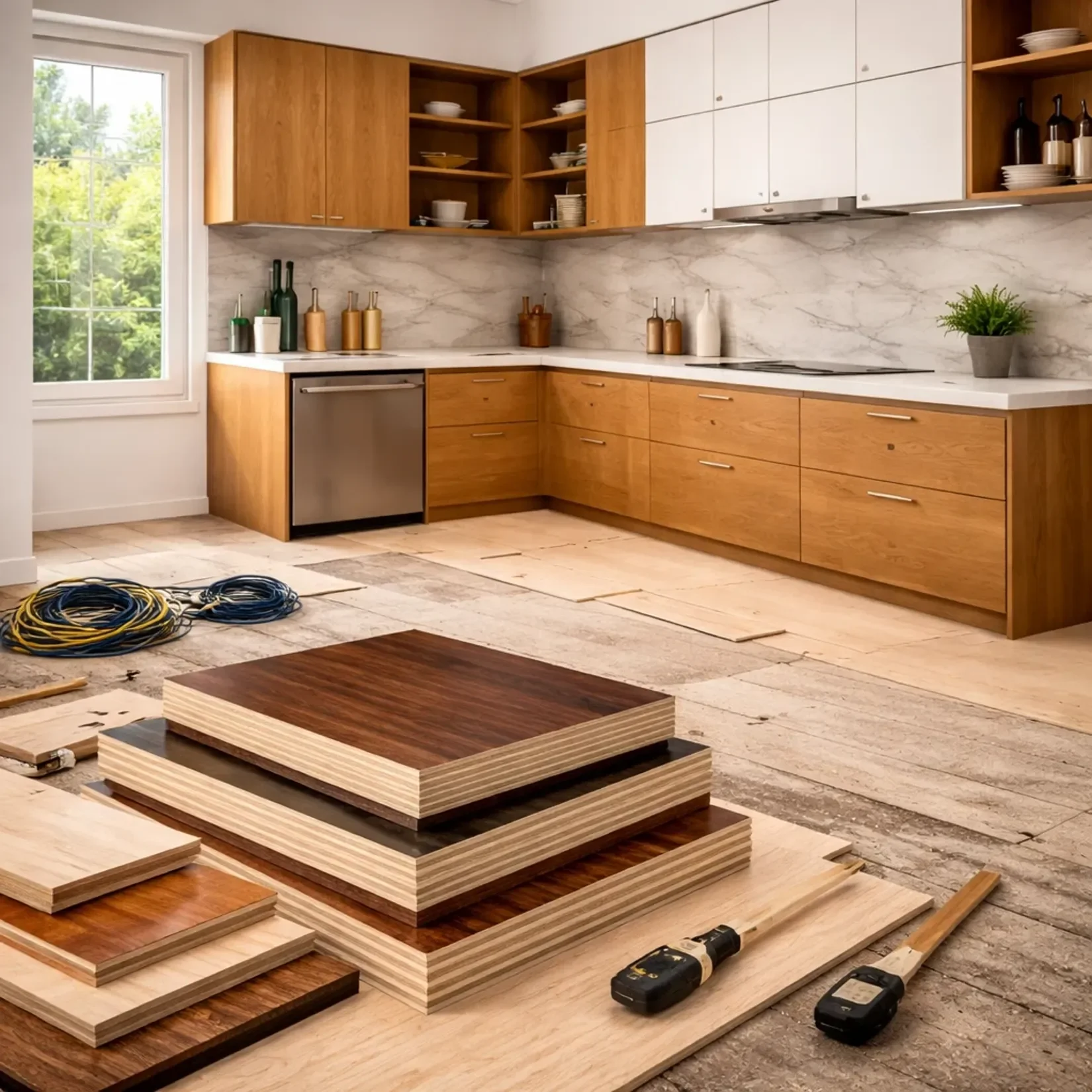
For items such as sink bases, wall cabinets, long shelving units, and heavily used doors, plywood is typically the best cabinet material. This is because it addresses the issues of load, moisture, and hardware holding in one board. In the dry areas of the cabinets, however, particle board can still be used if the edges are protected and the loads are average to light.
In bathrooms and laundry rooms, specify moisture-resistant bonding, sealed cutouts, compatible edge banding, and ventilation. Even a quality panel can fail when water remains at an exposed edge.
The panel around a sink deserves particular attention. Plumbing openings should be sealed after cutting, while joints near the floor should be protected against cleaning water, leaks, and condensation.
Wardrobes need flat panels, dependable hinges, and stable shelves. Hotels add frequent use, while retail and office projects may prioritize repeatable colors, CNC processing, and batch consistency.
A practical selection method is:
1.Use plywood for structural boxes, long spans, wall-mounted cabinets, and repeated hardware use.
2.Use faced particle board for dry, low-risk components where surface uniformity and budget are primary.
3.Confirm specifications with samples and test data before production.
For hotel rooms, commercial displays, and fitted office furniture, buyers should also consider replacement difficulty. A slightly higher-performing panel may provide better value when installed furniture cannot be repaired without interrupting business operations.
A purchasing specification should define thickness and tolerance, panel size, core or density, glue grade, moisture content, surface, edge-banding compatibility, environmental emission standards, and certificates. It should also state whether the panel is for boxes, shelves, doors, backs, or decorative fillers.
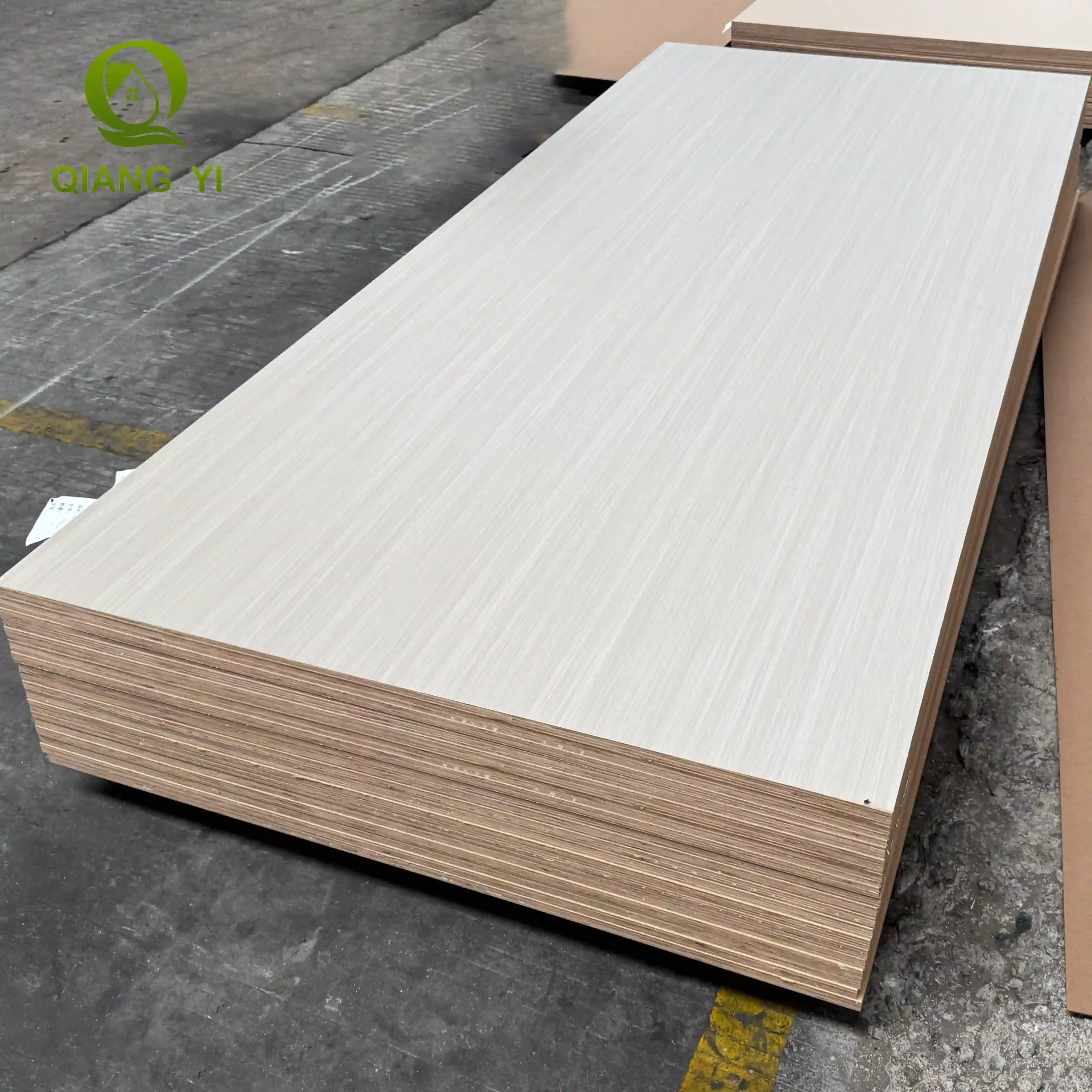
QIANGYI PLYWOOD was established in 2004 and manufactures plywood, particle board, MDF, blockboard, decorative panels, and related products. We support OEM requirements involving color, veneer, thickness, core, and surface configuration. For B2B orders, we recommend confirming the destination standard, application, processing method, and acceptance criteria before sampling.
A useful pre-order process includes:
1.Share the cabinet drawings and component list.
2.Identify structural, decorative, and moisture-prone parts.
3.Confirm thickness, surface, core, glue grade, and required certificates.
4.Test cutting, drilling, edge banding, and hardware installation.
5.Approve a reference sample before bulk production.
This process reduces misunderstandings between purchasing teams, designers, factories, and installers.
Glutinous rice glue plywood is worth considering when a project has higher requirements for panel moisture resistance, hardware durability, indoor environmental performance, and overall service performance in addition to conventional structural performance. QIANGYI PLYWOOD glutinous rice glue functional plywood uses a composite eco-friendly adhesive system made from glutinous rice starch, magnesium chloride, magnesium oxide, and purified water. It can be paired with high-quality cores such as eucalyptus and is available in 5 to 25 mm thicknesses, 5-, 9-, and 11-ply configurations, HENF or ENF glue grades, and melamine- or PET-faced finishes.
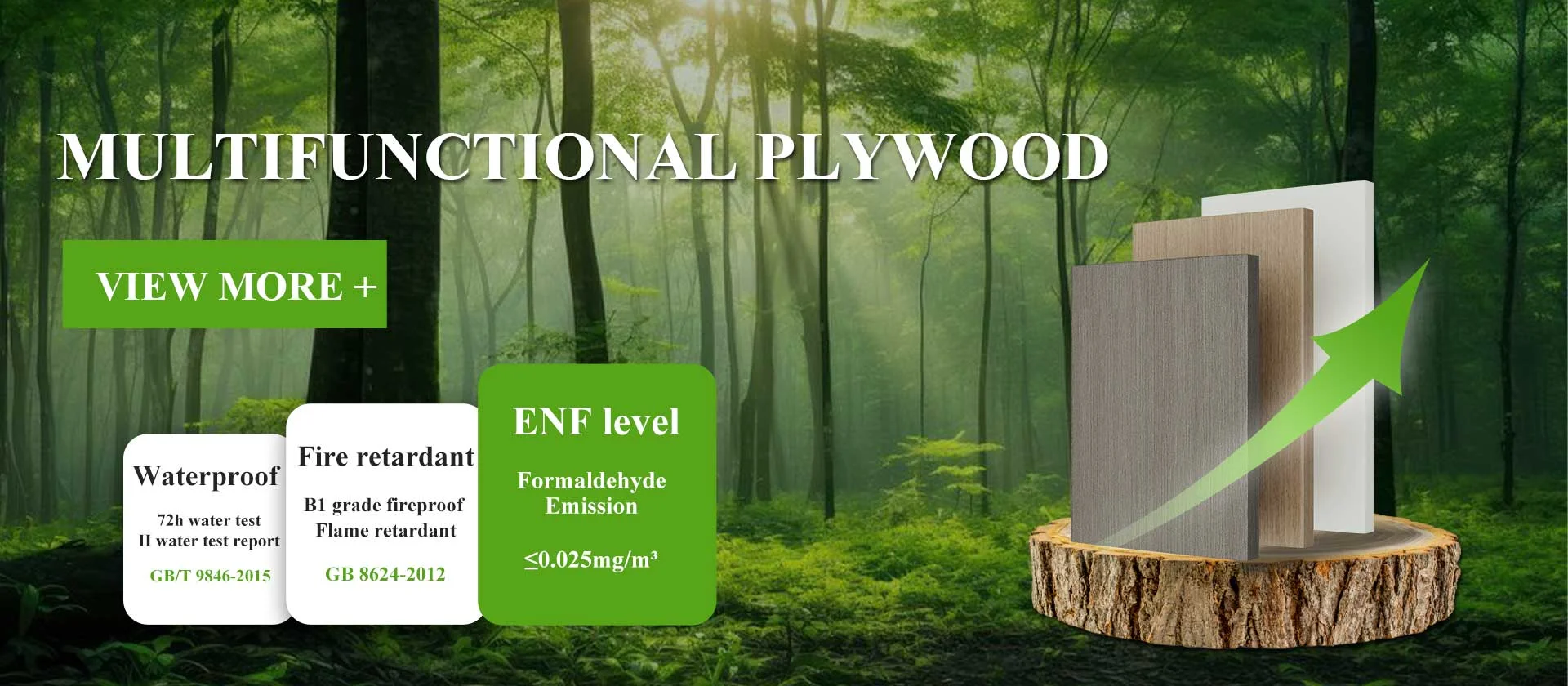
The product offers Class II waterproof performance, low formaldehyde emissions, mildew resistance, termite resistance, fire retardancy, and anti-deformation performance. A complete set of authoritative test reports can be provided to support the high-standard requirements of premium cabinets, custom furniture, and commercial fit-out projects.
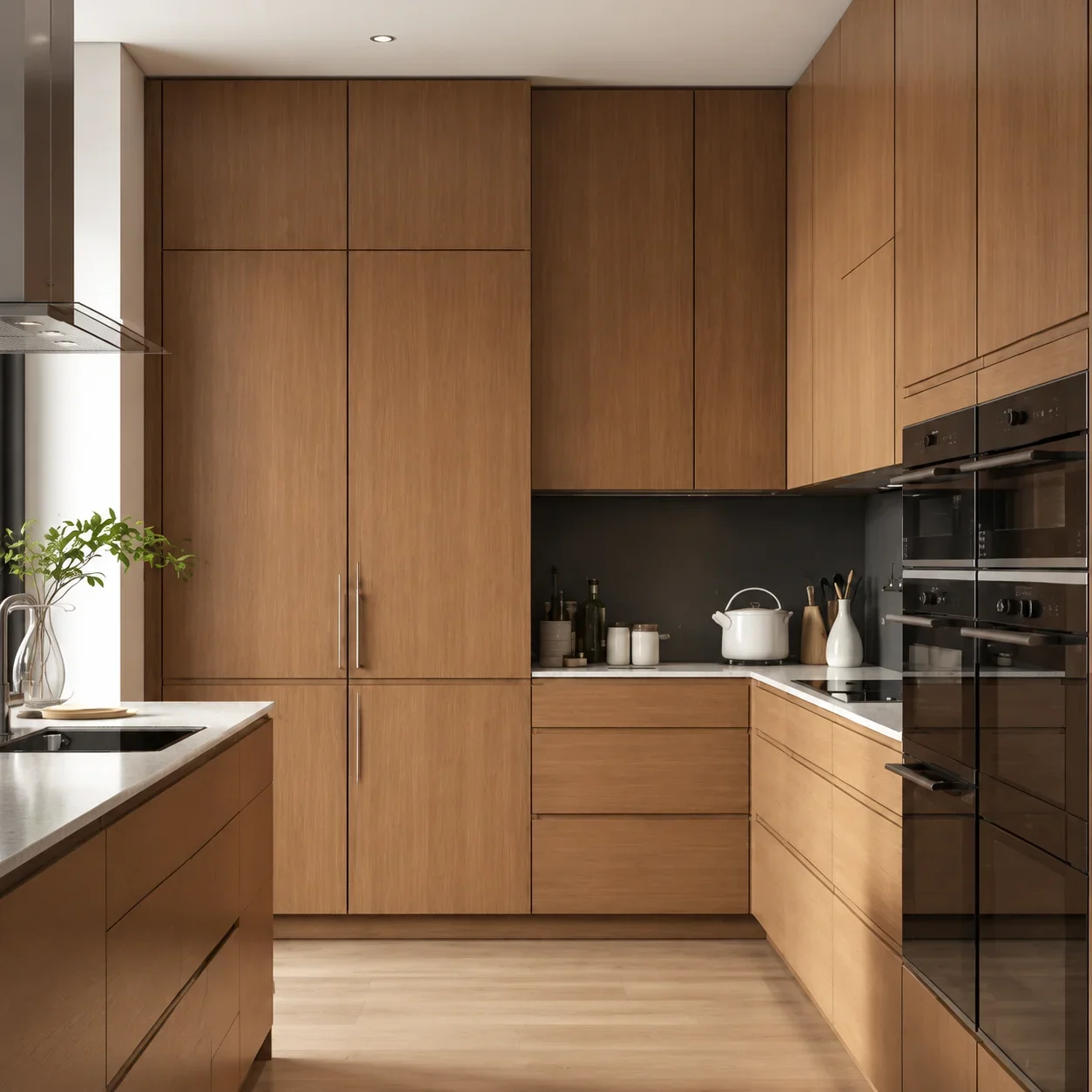
Kitchen cabinets, bathroom storage cabinets, hotel furniture, wardrobes and other indoor cabinets and furniture and installations can benefit from it, in particular when moisture, frequent use of cabinet handles or indoor materials are a special purchasing concern.
Because standards differ by market, buyers should request the relevant report, sample, technical specification, and surface confirmation for the exact product ordered. Our team can then match the requested thickness, core, finish, and performance documentation to the intended application.
A: Plywood is generally preferred for structural boxes, wall cabinets, loaded shelves, and areas near water. Particle board can suit dry, cost-sensitive components when it has adequate density, protected edges, and compatible hardware.
A: Properly bonded, moisture-resistant plywood is usually the lower-risk option. Cut edges, plumbing holes, joints, and sink openings must still be sealed because no wood-based panel should remain unprotected around recurring water exposure.
A: Plywood generally offers stronger screw retention because screws engage continuous veneer layers. Particle board requires careful fastener selection, accurate pilot holes, sufficient density, and controlled installation torque.
A: Yes, for many dry indoor cabinets with moderate loads and well-designed joints. It is less suitable where shelves have long unsupported spans, hardware is repeatedly stressed, or moisture exposure is likely.
A: Yes. It is highly suitable. QIANGYI PLYWOOD glutinous rice glue functional plywood is developed specifically for custom cabinets and high-end furniture. It supports customization in thickness, core material, ply configuration, and decorative surface, and delivers excellent environmental performance, moisture resistance, and structural stability. Before mass production, buyers should confirm the exact panel grade, dimensions, required certifications and test reports, and compatibility with existing processing equipment and production processes.
Please fill out the form below and we will get back to you as soon as possible.




Leave a Comments